"Educator"
January 23, 1983
The Hopes and Chip have given us blank bound books with requests that we write important facts that might be interesting to our grandchildren, great grandchildren and great, great grandchildren some years after we have departed. Carol was enthusiastic about the idea. I am not particularly interested in the project but Alice is. We thought it would be difficult to write in the books,so Alice said if I would write it, she would type it. I believe that by-gones should be by-gones and that future generations will not be interested in the detailed past of grandpa (Russ!) and grandma or great grandpa and great grandma and then even future generations, BUT I have promised Alice that I will write about some past events in our lives.
As I start this epistle, which will be pages long if I carry it out, I must say that Alice is the most important, unselfish person that I have ever known. As of this date, as I am 75 and Alice is only six weeks from being 75 and we have been married for 52 years, we have had a perfect married life. Alice allows me to think that I am the boss and make all the major decisions, but I'm smart enough to know better. She influences every decision I ever make.
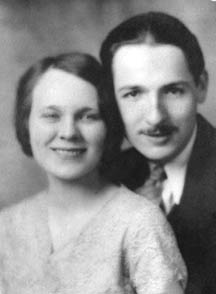
Russ and Alice circa late 1920's
Since Alice is so important to me, let's start at the beginning.
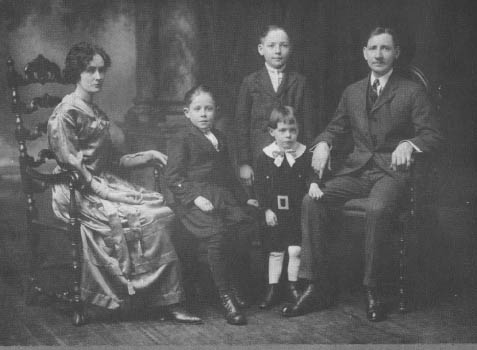
Russ (standing-rear) with parents and brothers
In 1912, our family moved from Lafayette Avenue in Bellevue to Van Voast Avenue in Bellevue, Kentucky. I was five years old. Brother Al was 3 years old. The twin brothers had not yet been born. My parents were in their twenties. Alice and her three older brothers lived across the street from us. Alice was my age but her mother was in her forties and her father was in his fifties; Alice had been a straggler. The other kids in the neighborhood also had younger parents than Alice's. We never called Alice's mother "Grandma Muir," but we thought of her as that, and she was the attraction of the neighbor- hood. All of the kids gathered at her home. She read to us, directed our games and was appreciated by the mothers who had younger children to care for. So, in 1912 Alice and I became good friends and good neighbors, and after 70 years we are better than good neighbors and friends. In 1913, Alice and I started to school in Bellevue at the Poplar Street School (now the firehouse). It was only one city block from where we lived, but between our homes and the school was a footbridge over the C & O Railroad; 12 steps up and 20 steps down. On the first day of school my mother called on Alice's mother to ask that Alice hold my hand over those dangerous steps Alice's mother and Alice agreed, and as I've said so many times, "she never let go."
I further became obligated to her. Brilliant a child as I was I could not tie a bow knot, so I couldn't tie my gym shoes as we had gym classes once a week. So every gym day Alice tied my gym shoes until the third grade. (*It was really fourth or fifth.) Then I caught on and didn't need her.
Alice was a tomboy. I was athletically inept. When the neighbor kids got together to play baseball in the C & O lot back of our house, we would choose up sides. Alice was always picked before I was, as was everyone else. I did like her, but I could never imagine loving a tomboy who was a better baseball player than I was.
We went through eight years of school together in Bellevue. We were both smart kids and good students. Alice really liked my brother, Al,better than she did me. He was fifteen months younger than I. (*I could "boss" Al, never Russ.) Most of the kids liked to play; I preferred to read.
As mentioned above, Alice said that if I would write this, she would type it; so, of course, she will add her comments as the story goes along, like this (*)
Did you know that I was the first pantomimist? Alice and I graduated from the eighth grade in 1921. Way back then they held eighth grade graduation programs because many students stopped at that point. Our eighth grade program included two or three songs. Miss Annie West, our vocal music teacher, made an unusual request of me. She said, "When the group sings, Russell, you just move your lips but don't sing." (*He made the main speech.)
When the eighth grade ended and we were ready for high school, that summer Alice's father died - at age 65 - SO Alice and her mother and three brothers rented their house across the street and bought a small farm in Milan, Indiana. So Alice went to high school in Milan; I didn't see her for four years.
I had a high school experience that changed my whole life. I was an "A" student scholastically in a senior class of thirteen graduate' but Lucille Derrick ended up as valedictorian. She was an "A+" student, but this story goes back to my junior year in high school. I was president of the drama club. On Lincoln's birthday it was decided that we should have an assembly during the period before lunch. The school band would play and there would be some short talks by the drama club leaders. We found this out at 8:30 a.m. Miss Gibson was our sponsor. She suggested that the closing event should be the reciting of Lincoln's Gettysburg Address and as president of the club, I should read it.
I was an egotist scholastically, although a failure athletically. I said that I knew the Gettysburg Address and didn't need to read it, I would recite it. So, the unprepared program went on. As president, I made the introductions of the short speeches and the band numbers. Then it was time for the conclusion,the quoting of the Gettysburg Address. You know that it's a very short speech. I had no fears or lack of confidence, but something went wrong, I found that I was repeating myself and the student body laughed. I repeated myself for the third time and the students roared. I could not finish and they all applauded my failure.
I went to my room, gathered up all of my belongings and went home. We didn't have lunchrooms then. I told my mother I was quitting school in disgrace.
Ten minutes later my freshman brother Al came home with all of his belongings. He also was quitting school after the way his brother had disgraced him.
Leo Gilligan was our principal. That evening he came to our home. He became a friend of the family and the greatest single person to influence my career. That evening he convinced Al and me to return. My assembly disaster was minimized.
Leo Gilligan coached the speech events at the school and hoped that the following year he could have a debate team. Upon my return to school next day I became a member of the speech group. I was assigned to oratory and was given an oration to memorize. It was "Sparticus to the Gladiators." Our other oratorical speaker was Stan Moebus. He had Patrick Henry's speech to the congress.
Gilligan coached us every day, along with other contestants in other speech events.
In April of 1924 the district speech contests were held at Crescent Springs High School. There were ten schools competing. Not all ten schools had contestants in all events but in Oratory there were ten contestants. Each school was allowed two entries, so there must have been fifteen or sixteen in the oratory contest. I've never had a more nervous day nor such a boring day of oratory, but the results were good. Stan Moebus and Patrick Henry won first place. Sparticus and I came in second; my ego was restored!
Then in my senior year we had a debate team. Five Bellevue students qualified in Gilligan's opinion, but we needed an affirmative team of three debaters and a negative team of three debaters, but we had only five members. Gilligan solved the problem by putting me on both teams. My ego was further bolstered. We easily won the district championship but couln't go to the state tournament because the school couldn't afford the expense nor could the debaters, with hotel, meals and transportation.
In our graduation class of 1925 we had thirteen graduates. I was an "A" student but Lucille Derrick was an "A+" student. She was really a brain and later became a Ph.D. college professor, so I was salutatorian; Lucille was valedictorian.
I was a very slow starter romantically, but late in my senior year I became interested in the Methodist preacher's daughter. She and her parents lived in Covington and she went to Holmes High School but I did manage to see her on Sundays at Methodist Church youth group meetings and we had dates on many Sunday evenings. She was Edythe Litteral and really a doll. (*Would you believe it, I never met her.)
The summer after my graduation in 1925 I sold Fuller Brushes in order to earn enough to go to Miami University in the fall. My territory was Covington. Dad had bought his first car, a 1921 Ford touring car and he let me use it for my Fuller Brush sales, so every day at lunch hour I stopped at Edythe's house.
My boyhood friend, high school friend, and neighbor, Bob Rudd was also interested in Edythe. He also was selling Fuller Brushes and his territory was Latonia. It was amazing that two or three days a week Bob and I would meet at Edythe's house. Edythe was a year behind me in school so she still had another year to go at Holmes High School.
I was not concerned about Bob's competition. It was obvious that Edythe preferred me. My parents liked her and on Sunday afternoons I would take her to our home. She was just the girl I wanted.
THEN, everything changed and loused things up. Alice, her mother and her brothers moved from Milan, Indiana back to their home across the street from us. I hadn't seen Alice for a long time and how she had changed since the eighth grade. She was far different from the tomboy I remembered. I began to feel sorry for Edythe.
Alice and I saw a lot of each other that summer, but I was going away to college. Alice enrolled in business college in Cincinnati.
I really liked Edythe and enjoyed her company. I could have well eventually married her if she had agreed. Then came Alice She stirred me sexually. I gradually saw less and less of Edythe; I let Bob see her, but she didn't marry him either.
Russ said I should add some comments at this point about my high school years. Just one comment on above...I would have liked her better if she had spelled her name "Edith." I sure didn't want to be "Alyce."
I was thirteen the summer my father died at 65. He died suddenly on the third of July. I loved him so much. I know now that he was more like a grandfather to me. My mother was devastated. He had always taken care of everyting. She had been reared on a farm and although they had been poor, they always had
plenty to eat, so, seeking security, she bought a small farm at Mllan, Indiana, and Joe and Paul, my oldest and youngest brothers, and I moved there in August of that same summer. Willard "Biddy" my middle brother was working as an engraver and stayed in Bellevue and worked in Cincinnati.
The people from whom we bought the farm couldn't get possession of the property they had bought on the other side of Milan, so we shared the house for several months till they moved.
How lucky can a thirteen year old girl be? Living with the couple from whom we bought the farm was a tall, handsome fourteen year old boy and his younger sister. We got to be great friends and it made it a lot easier for me changing schools to have Harley Walden take me to school and introduce me. (He was a grade ahead of me.) I thoroughly enjoyed high school. I made good grades (practically all "A' s) and lots of new friends. My "best friend" was Hilda Allen, who lived in "town" and I stayed with her whenever I wanted to; I was always welcome. We kept in touch and she died just a year ago. She became a teacher and taught both Laura Lee and Alice May Muir. She never had a date, but I always tried to manage it so she got to go along to parties and such with me and my date. I seldom lacked a date for school affairs' and had many boy friends as well as boyfriends Dudley Wilson was a neighbor and I used to go fishing with him in the summer, but took my book along and sat on the bank and read while he fished. The boys I dated that I really liked were Bob Busteed, Johnny Cain and Harley Walden. In my junior year (Harley's senior year) we "went steady."
I was crazy about him. When he graduated, he went to live with his father in Waterloo, Iowa. Before he left, he gave me his grand mother's engagement ring to remember him, but we didn't promise not to date others. During my senior year, I didn't "go steady" but next to Harley, I liked Bob Busteed best. He was also dating the girl he later married. Harley and I continued to correspond.
(In 1975, at our 50th Class Reunion, Bob flew from Texas, where he is a college professor, "especially to see Alice" he told Russ.)
The summer I graduated (1925) my brother Joe got a job in Cincinnati, Paul later went to work for Biddy, so we moved back to our house in Bellevue, which we had rented for the four years.
I enrolled in a two year program at Littleford-Nelson Business School and finished in a year and a half, and got my first job with Acme School Supply Company on Third Street in Cincinnati as a secretary at (big deal) $15.00 a week. I met, and dated, a boy from Bond Hill named Jimmy Bevis who was also a student there. I also dated Roy Leithner, a Bellevue boy with whom Russ and I had gone to elementary school. He later became a bartender at the Avenue in Bellevue and we saw him occasionally. He married a nurse and they sent all their kids to college. He was a nice looking, nice boy.
At this time, Russ was going to Miami. His family really liked me, and they would often take the "neighbor girl" with them when they drove up to see him on Sunday. During his second year, he invited me up to Delt dances, games, etc. (I guess this was when he was beginning to be "sexually stirred" by Alice.)
I was still corresponding with Harley, but hadn't seen him for over two years. One day I got a "Dear John" letter from him. I hadn't hesitated to tell him about my dates with Jimmy, Russ, and Roy, and he said in his letter that I was probably far more interested in them than him, and would I return his grandmother's ring? Of course I did, and wasn't heartbroken, but I still thought alot of him. I immediately wrapped and sent the ring, with a not-too nice note.
Not too much later, I heard he was married to a girl in Waterloo. To finish up this story, instead of going back to it later, about a year after the above letter, Harley came to Cincinnati on business (he had some kind of executive job with John Deere Tractor Co.) and called me. He said his marriage wasn't going so well and he was still interested in me and would I meet him and talk it over. I was really still interested, but not enough to "talk things over" with a married man, so I didn't meet him. He had come over to Bellevue in the afternonn while I was still at work and Mom showed him my picture and he told her he was still in love with me. I never heard from him again.
Russ continues....The summer after graduation I had made enough by selling Fuller Brushes to pay my tuition at Miami University but I really was financially not able to go to college. Mother and Dad promised to send me $5.00 a week to pay for my meals at the
Commons. Dad got paid on Friday night. They would mail my $5.00 on
Saturday and I should receive it on Tuesday. On each Tuesday I received a letter from Mother. Most of them said, "We just can't send $5.00 this week; we'll try to do better next week." But how was I to pay for the meals that week?
Uncle Bob, Dad's brother, and his wife Lena ran a taxi company in Oxford, so I asked him if he could use me to help out. They had two 1924 Dodge sedans which they used for their business. They also had a 1919 Ford which they didn't use. (I'm talking about the year 1925.) They put a new battery in the Ford and agreed to use me during their two rush hours each day.
"Western" girls college was two miles from towntown Oxford and their classes ended at 4:00 P.M. They had to be back for dinner at 6:00 P.M. They were allowed to leave campus for those two hours. Dozens of them wanted to go up town at 4 o'clock to fill up a restaurant whose name I can't remember, so at four Uncle Bob and Lena would be at the exit door to take them uptown. They would often have six to eight girls in each Dodge at 50¢ per trip. Many girls were left behind for lack of transportation, so they really could use me and the old Ford. My pay was 25% of the fares I collected. Then at 5:45 we met the girls at the restaurant and took them back to Western.
It was a godsend for me as well as Uncle Bob. I made about $2.00 a day and was paid by the day. (*I asked Russ if he ever got a tip. He said, "Not in money.")
There were also other calls for taxi service from Western and after a time some of the girls asked that they send "Andy" and his old Ford. I got to be friends with many wealthy girls. Western was an expensive college.
I must tell this story. A junior at Western was intimately involved with a musician who travelled with a band. Although older than I was, she became a very close friend and was my best taxi customer. She always asked for me.
During the Christmas holidays when she was home in Philadelphia she wrote a letter to her boyfriend and a letter to me at my Oxford address. She put the letters in the wrong envelopes so I received the one meant for her boyfriend. She told him how much she loved him and how much she missed the sexual "adventure" when he was away. She said, "I've had only a few dates. I've had several with a young Delt who furnishes free taxi service. He's good company, but he's too young and too innocent to be considered as competition." I was humiliated. I wish I could have read the letter that was meant for me. I can't even remember her name.
There was no way that I could join a fraternity at Miami in my poverty condition, but Mother insisted that I must. She would pay the $50.00 initiation fee. I was rushed by two fraternities: Delta Tau Delta and Phi Kappa Tau. The Delts were very frank and honest. They had a meeting with five pledges, of which I was one. They said, "We are a football fraternity. Half of the football first stringers are Delts, but we are weak scholastically. You five fellows are 'A' students and we need you." Four of the five of us became Delts.
Now, as a fraternity member I was poorer than ever. The meals at the House cost more than the meals at the Commons. Uncle Bob gave me all the work he could, but it was not enough, SO I took a job at a restaurant as a night chef. I worked seven nights a week from 9:00 P.M. till 1 A.M. I received all my meals free plus $5.00 a week.
The fraternity house where I lived was two miles from the restaurant, but I had the use of Uncle Bob's old Ford.
Now, this restaurant job was in my sophomore year. I have lost my continuity.
I must back up and tell you about my freshman year in Stoddard Hall and my roommate Carl Phillips. He was a country boy from Ohio, raised on a farm and as financially poor as I was. We became good friends immediately and remained so for the two years I was at Miami. Carl stayed all four years and graduated from Miami. He became a teacher, then a principal and eventually a superintendent in Ohio. (*A generation later, his niece became a good friend of Carol's at Miami, also her roommate, Carol says.)
Before classes started all freshnen had to take qualification tests in five fields to determine to what level of classes we should be assigned. There was English, math, social science, science and I forget the other one. In each field we were rated from one to five, which meant A, B, C, D. and F. I was warned not to do my best in English because the advanced English classes were most difficult and time consuming. I was afraid not to do my best. Having done so well in high school I had no doubt that I would score #1 in all categories, but was I ever disillusioned! I scored #1 in English, #2 in three other categories and #3 in math, after having all "A's" in math in high school.
Carl scored #1 in math, #3 in three other fields and #5 in English which meant that he had to take remedial English.
Carl was really outstanding in math I made "A's" in all my math classes, but it was due to Carl's tutoring rather than my in structors. English was another matter. I was in an advanced English class with an instructor, Dr. Clubb, who was a Harvard PhL, teaching for his first year. He had been told to be tough and he was. Each week we had to write an essay. I made an "A" on every one, but the professor made marginal notes on all the papers, saying "This would have been better." Poor Carl, on his first three papers made'D's or F's. So we made a deal. He would give me more math help and I would let him copy my "A" English papers, even including the improvements suggested by my professor. His essay grades improved. He received a'C-" on each one. I learned a fact of life. You are labelled by your teacher by the level of your class. I was an "A" student in my class and Carl was a "C-" student in his class, so my "A" papers were Carl's "C-" papers; gross injustice.
There was no way I could go back to Miami for my third year. Besides, it was brother Al's turn to go to college, as a poverty student. So, I sold Fuller Brushes again that summer and enrolled in the YMCA night Law College. It took only two years of college to be eligible in 1927. Arthur Hall, a lawyer and neighbor, offered me a job as a law clerk in his office for $12.50 per week.
I must back up and tell something else about Carl. I was going through "Hell Week" at the fraternity, the final night. I was told of my final ordeal. I was to be taken to the cemetery and put into an open grave into which someone would be buried the next day. There was a sad coincidence. It was pouring down rain that night. That would make it harder to climb out of a newly dug grave.
Cars were not allowed for students, so at 10:00 P.M. my two fraternity FRIENDS walked me to the cemetery. On the way we passed my dormitory so I asked if I could stop in and use the bathroom. They allowed me five minutes. I found Carl in our room and told him my story. He promised to rescue me. I was back with my FRIENDS in five minutes and was soon deposited in the flooded grave. There was no way I could climb out. Fifteen minutes later Carl arrived and pulled me out. I went back to our room, went to bed and slept till 7:00 o'clock. I then went back to the cemetery, got into the wet grave and waited for my FRIENDS to rescue me at 7:30 as they had promised. They did.
On that final night of "Hell Week" a worse thing happened. We had pledged a "legacy" whose father had been a Delt. The father was a doctor in a small town in Ohio. The pledge was really obnoxious. So, his last night penalty was really something. The Delts would rather kill him than have him as an active member. He believed them. The members made a box to resemble a coffin and put him in it. They were going to put the box on the railroad track in time for the 11 o'clock train passing through Oxford and let the train kill him. He believed it.
What they did was to put a 2x4 beside the track and let him think he was on one of the rails. The train arrived on time, the whistle blowing, and the Delts opened the box. The pledge was unconscious. He was taken to the University Medical Center where he stayed for two days. (Nice guys, those Delts.)
The university revised "Hell Week" extremes. The Delts were put on probation. The plan worked, though. The obnoxious kid dropped out of Miami. The doctor father's threat to sue did not materialize.
Now back to the miracles of my life.
I had finished two years at Miami majoring in business administration. I had passed the YMCA night law college entrance exam, I had a job as a law clerk, so I was on my way to a legal career.
I'm talking now about early September, 1927. I was nineteen years old, but would be twenty in October.
On Labor Day my High School Principal friend Leo Gilligan called me. Would I be interested in going to the Cam pbell County Pair with him? I said that I was free for the afternoon and would be glad to go but I'd have to be home by 6:00 because I had a date with Alice. That was agreeable.
Soon after we arrived at the fairgrounds we ran into John Reilley who was Superintendent of Campbell County Schools. So, the superintendent and the principal started to talk about school problems. I was bored.
Poor Supt. Reilley had a serious problem. His largest one room school in the county was at Melbourne. The previous year they had had three teachers. All had quit. Two of them, said Reilley, had had nervous breakdowns. The school had 64 students in all eight grades. The teacher had 41 classes a day from 8:30 A.M. till 4:00 P.M. but in the winter months and on cold days the teacher had to get there at 7:00 A.M. to build a fire in the center of the room "pot belly stove." Reilley said that the trouble was that the young girl teachers just couldn't take all that.
As I listened in boredom I could understand why the three young women teachers had quit. Then Gilligan said, "John, you need a man for that job. No young woman teacher could handle that assignment." Supt. Reilley asked, "Leo, where could I find a man to take
on that job?" Gilligan answered, "He's sitting right there beside you, Russ Anderson."
Then they both started to work on me. After several hours
I answered, "It does sound like a challenge, but in two weeks I'm scheduled to start in night law school, but I will give it some thought and let you know." Reilley replied, "Russell, you don't have time to give it much thought because school starts tomorrow."
The next morning at 7:30 I arrived at the Melbourne one room school. By 8:00 o'clock there were 64 kids, at least 40 mothers, the woman Trustee and, luckily, Supt. John Reilley. It was indeed a standing room crowd as the superintendent introduced me. It was a difficult day for a nineteen year old, but within a week everything was under control. I liked the kids, and they liked me. A man teacher was something unusual.
Now I had to solve my car problem because Melbourne was ten miles from home. Dad had a 1926 Ford touring car, which I used for the first week. Then on Saturday I shopped for a used car. I found a nice 1922 Ford roadster, only five years old and in good condition. All it lacked was a curtain for the passenger's side. It cost $75.00. I paid down $15.00 and signed a 12 month note for 55.00 a month and you won't believe this: no interest. I bought it through the Ford dealer in Newport.
I withdrew my application for the YMCA law night school and was refunded my 525.00 deposit. I resigned from my $12.50 per week law clerk job. I was now really in big money. My teaching pay was $90.00 per month for the eight month school year. Imagine, $720.00 per year and four months off to earn even more!
Now I had to work on my college degree. With only two years of college I qualified for a temporary teaching certificate good for four years. I decided to qualify in two years, so I registered at University of Cincinnati night school to get a BS in Education. I registered for twelve two hour classes. Five nights a week I had two classes per night from 6:30 to lO P.M. On Saturday morning I had two classes from 8 AeMe till noon. I had very little spare time! I studied and wrote papers each night till at least 1:00 A.M. Then to school by 8:00 A.M. in good weather and 7:00 A.M. on a cold morning in order to start the pot belly stove.
Then I had another financial break. A teacher who lived in Dayton taught in Silver Grove and she went to work each day by train. She heard of me and my driving to Melbourne and back each day. I made a deal to drive her back and forth each day. My suggested charge would have been $3.00 a week but she beat me to the deal and offered $5.00 a week. She hated going by train because she couldn't get a B & O train from Silver Grove to Dayton till 5:30 P.M. I picked her up at 4:15.
Alice and I were dating on weekends but we had not gotten too serious. When I'd get home from UC at 10:30 each night I'd walk across the street to see if there were lights on. If there were, I'd go in and visit a while.
During the second semester Alice and I had become more serious so she registered in a Wednesday night psychology class that I was taking and we went to class together. That was a big break for me because she did all the preparation and homework for both of us, even typed the assignments.
The summer after my first year at Melbourne I went to school in the mornings and sold Fuller Brushes in the afternoons.
My second year at Melbourne was also enjoyable and I continued my five nights a week and Saturday schedule at U.C. I would graduate in the class of 1929 and still have worked full time for two years. In June of 1929 I would have a full fledged teaching certificate, having a B.S. degree.
Alice and I saw each other at every opportunity. We were now in love and talked about marriage when finances permitted.
If I do say it myself our children, grandchildren and great grandchildren have been most fortunate to have had Alice and Russ, and as of February, 1983, Alice and I have had 52 years of happy marriage. Alice is the most lovable, unselfish, wonderful person I have ever known.
(*You all know how much I love Russ.and think he's "the greatest." Just in the last few days I have had two people who hardly know me say how happy I always look. Russ has everything to do with that.)
Here's Russ again. This is about a street car miracle which changed everything in all of our lives. Without that miracle Alice and I would not have married and where would that leave all the rest of you?
On New Year's Eve of 1928 I made a social blunder that almost changed all of our lives. (Alice may change some details.) As I recall the incident, Alice had invited three couples to her home for New Year's Eve. I don't even remember who the other couples were, but that day my long time boyhood friend Bob Rudd, called. He said that he and his girl friend, Gertrude, had no plans for the night. Could Alice and I get together with them and go some place? I said, "Alice is having several couples at her house. Join us." They did. I was the first one there and told Alice I had invited Bob and Gertrude to join us.
At least twelve times in 52 years I have seen Alice mad about something and maybe twenty times I have seen her upset, but on that night it was the only time that I have ever seen her furious.
She had everything set up for a party of eight. The dining room table had eight place settings. There were favors" for eight. The house was decorated with flowers and balloons; all set for a delightful evening, which it was not. An extra two people loused up everything.
Some time after midnight the disastrous party broke up. The guests left and I stayedto help Alice clean up. She said, "You ruined my party. I don't want your help. Please leave. I never want to see you again."
I answered, "That suits me. You will never see me again." We really did love each other and always have, except for that one night.
(*These are Alice's comments.) The above was bad, and was just about as Russ tells it. However, it was the culmination of alot of little things, and not just the party. I think as it turned out it was good it happened. We were very much in love, we wanted to get married, we weren't ready financially. As you can see from all the above, Russ was pretty much of an egotist. He had lots of reasons to be: he was smart, he had worked hard to work full time and still graduate with his class of 1929, and he had a good job, and was still only 22 or 23. I had gone to business school, had an interesting job that paid about $20 a week, had taken a couple of courses with him at UC, had taken some English literature courses by correspondence from the University of Kentucky, a drama class in Cincinnati, and always read, read, read everything. I felt in my heart and head that I was probably as well "educated" as he, and almost as smart, but I didn't feel that he felt that! As a young fellow, he was kind of "stuck on himself" and rather thoughtless. He sure changed before you all knew him, didn't he? However, that was the way I felt, and, as I said, the party to which he invited two extra guests without consulting me, was the culmination of all this.
I really suffered that nine months, but I was too stubborn to call him, and he to call me. The separation really "cleared the air" though. We learned the tough way how much we cared.
Now, Russ continues.
For nine months we never saw each other or called each other. She dated several other fellows (*the only one who mattered was Don McClanahan with whom I worked at Dorger and Dorger), and I had no dating problem. Gertrude Spurlock (Bob's girlfriend) was a telephone operator and many of her operator friends welcomed a weekend date.
I was too stubborn to call Alice and in 1928 no respectable girl called a fellow. It was a miserable nine months.
Then in May, 1929, my friend Gilligan called me. He said, "The Cold Spring school board has fired its principal and all of its teachers. I believe that I can get you that principalship." I applied, visited each of the five board members, must have impressed them, because I was elected at $180.00 a month for nine months. I had really hit the jackpot. I raised a mustache so that I would not be mistaken for a student.
In July the KENTUCKY POST published the story of my election as principal of the Cold Spring School System. It was an independent school; I was the head of the school. The headline read something like YOUNGEST MAN EVER T0 BE ELECTED TO HEAD A SCHOOL SYSTEM. My picture was included. It was my high school picture, without my mustache. I was 21 years old.
Of course Alice and her family read the article and I'm told that Alice's mother said, "You sure missed the boat, didn't you?" (*I heartily agreed.)
The publicity also caused reaction among Cold Spring citizens. A well attended protest meeting was held in the school gym. The theme of the meeting was that the school board should not have hired a boy to do a man's job. I heard all about the meeting, but luckily the KENTUCKY POST did not publish the story of the protest On the first day school, I had a religious experience in prayer that I have never forgotten. As I arrived at school that :
first day the place was a mess. There was a second story being added to the building. It was to have been finished in August but it had not been completed. The workers were noisily working on the construction. The gym had been partitioned by tarpaulins into four classrooms.
Then, the secretary of the board sought me out and said, "Professor, I have bad news. The students are protesting the firing of their principal and all their teachers and when the bell rings they're not going to enter the school." The word "strike" was not used then in connection with schools.
What was I to do? I had given up the pursuit of a law career and my high school principalship was going to be less than one day long. I could imagine the KENTUCKY POST story!
I went up to the second floor into the room that would have some day been my office. I had never seen any of the 150 kids who roamed about outside. I had never met any of my six teachers. It was indeed a hopeless mess. So, I prayed, and you'll never believe how my prayer was answered. I still can't believe it.
As I looked out the window of my unfinished office, I saw one boy that I recognized. He was Bud Schweitzer. His father was on the school board and when I had visited the father when applying for the job, I had met his whole family: Bud, Bill and Aleen (about whom you'll hear later.) So what? I recognized Bud.
I went to the school yard and spoke to Bud. He remembered me. Then God put words into my mouth that I could have in no way ever thought of. I said, "Bud, do you have a basketball team here at Cold Spring?" He answered, "No, we don't have anything but classes." I asked, "Are there enough boys in high school big enough to have a team?" He said, "Sure." I said, "Go talk to the boys and have them line up in there and I'll measure them for basketball uniforms. Have them line up in order of size starting with the tallest." Off went Bud.
Then another miracle happened. Measure them for uniforms, with what? I carried no tape measure. The teachers all knew of the "no entry" protests and were all very nervous. They were gathered in the hall and getting acquainted. I told them what I had done and what I hoped for. Now the miracle. Helen Overman, a high school teacher, said, "I have a tape measure in my purse, I'll get it."
Within fifteen minutes thirty boys were lined up in the gym in order of height and I started to measure. I had told Miss Overman to ring the bell when I gave her the signal.
After I had measured about ten boys, I made an announcement. I said, "It's time for the bell to ring but you boys don't have to go to class till I finish measuring you' but if anybody steps out of line he loses his chance to be on the basketball team."
I gave the signal. The bell rang and not one boy stepped out of line. The elementary kids were no problem. The high school girls, with all the boys inside, went into school when the bell rang. Disaster was averted.
Now the miracle for which I give God credit was the words he caused me to say. I would never have used athletics...at high school in Bellevue I went out for all sports and was always among the first to be cut. I was not interested in athletics. I was a scholar and a reader. I had no athletic ability. BUT, now I found myself as a basketball coach.
School started as scheduled. The student protest ended miraculously. I should have been very happy, but missed Alice.
I had thought about her every day since New Years Eve when she said she never wanted to see me again. I could be as stubborn as she was.
With a boys' basketball team in prospect at Cold Spring, the girls wanted a team, too, so what could I say? I didn't want to initiate discrimination, so now I was the coach of two basket-ball teams.
I was determined to have a debate team, so I found myself very busy, but I did not have to go to U.C. at night. I also decided to have a school paper.
It was now October and I was twenty-two years old.
Then another miracle happened on a streetcar (*named South Bellevue, but it could have been Desire.)
There was an outstanding movie in a Cincinnati theatre so I decided one evening to go to see it. The streetcar stopped at our corner, so I waited and boarded. We had moved from Van Voast Avenue to Ward Avenue, three blocks from where Alice lived. On that same evening Alice had asked her mother to meet her over town to have dinner. As fate would have it, Alice and her mother were coming home on the car that I boarded. We had not seen each other or spoken to each other for nine months. We spoke.
My heart throbbed all the way to Cincinnati. I gave up the movie idea, stayed on the streetcar and went home.
Alice's mother told me later that they got off the car at their stop and that she leaned against her mother and cried. Mom Muir asked her, "Do you still love him that much?" Alice answered, "Yes, I do." Mom said, "Then do something about it." But what could a girl do in 1929?
When the first issue of my school paper was ready for distribution about October 20, I mailed one to Alice. Since my birthday was on October 25, she sent me a birthday card. They crossed in the mail.
Even though stubborn, I was courteous, so I called her. That was the beginning of all the years of loving happiness. We started dating again and for the Halloween school party I asked her to help me chaperone. Alice and the senior boys had a ball. They didn't give me a chance to dance with her. *(It was really fun, and I was so glad to be dating Russ again.)
I was a very poor boys' basketball coach; my boys' team won only one game that first year. My girls' team won most of their games. I guess I have a way with women.
I won the community to my side at age 22. The attenders at the protest meeting became my friends. Naturally I had a debate team which gave me a very busy schedule. In addition to being principal I taught six classes a day. After school I coached basketball. The boys and girls practiced together. We ended up each practice with a fifteen minute scrimmage; the boys against the girls. Almost always the girls won!
Then in the evenings I met my debate team. The first year, before Alice and I were married, we met alternately at the debaters' homes. For the next four years, after our marriage, we met in the evenings at our Highland Heights home. I was much better as a debate coach than I was as a basketball coach.
My younger brother, Al, whom you grandchildren loved so much and knew as "Unkie Al" stayed out of school for a year after high school graduation. Then he went to the University of Kentucky and majored in basketball (!), so instead of being two years behind me in schooling, he was three years behind me and what a lucky break that was for me.
(*Russ forgot, the summer before Al went to U.K. he went to Berea for the summer. In the first place, his name was "Alvia" and so when he got there, he was assigned to a girls' dorm. He always said he was too dumb to take advantage of it, so ended up in a boys' dorm. He also always said, "I spent a year at Berea one summer." He hated it.)
Al graduated after my first year at Cold Spring and was hired as a junior high school teacher and basketball coach at Silver Grove, but as a coach he had a difficulty. Silver Grove didn't have a gym. His boys and girls teams practiced outside and played all "away" games. So I made a deal with Al. If he would come to Cold Spring after school and coach my boys' team he could use my gym in the evenings to coach both of his teams. I would keep my winning girls' team.
He did a wonderful job with my boys' team. The zone defense was practically unknown except at U.K. and Al really knew it and used it on both his boys' team and mine. Both of our boys teams were winners and both ended up in the District Tournament at Dayton. Then poor Al almost lost his job at Silver Grove. A KENTUCKY POST sports writer headlined his article on the tournament "ONE COACH WILL BE A SURE WINNER TONIGHT AT DAYTON". Then the article went on "Cold Spring meets Silver Grove, and Al Anderson is the coach of both teams." Silver Grove fans and other citizens were upset.
On the night of the game Al never came near our Cold Spring team. I ran the team from the bench. I wanted the game to be close, but I wanted Al's team to win. Al's team did win by a few points.
Al explained the double duty to his school board and they understood. They approved a bond issue to build a gym in Silver Grove. For one more year Al coached both boys teams but not secretly; then the following year he had his own gym.
Now, Al had nothing to do with my girls team. I was their coach, but he came to most of my practices. With a completely incompetent coach my girls won two consecutive district championships. We never won beyond the district and luckily, Al's two boys teams didn't meet in a tournament game again.
Al had a two-fold interest in my girls team: Maybelle Schneider and Aleen Schweitzer, both very good players and both very attractive girls. Maybelle was a senior; Aleen was a junior. Maybelle had lots of boyfriends but Aleen's strict parents didn't let her date, so Al concentrated on Aleen.
When she graduated, she didn't go to college nor did she get a job. Her father was opposed to both, but a year after she graduated, a year of helping her mother in the home, she and Al married. She was a doll and Al was a good guy. They were lucky to get each other and had three lovely children, Peggy, Alan and Jerry.
(*) I, Alice,want to add something about Al at this point. He went on to be superintendent at Silver Grove, then came to Fort Thomas, coached basketball for a while and was principal of Ruth Moyer School till his illness made him retire. All our grandchildren (with the possible exception of Barb) had Al as their principal at Moyer Elementary. They all loved him very much, as did Carol and Chip. Todd was a pretty good artist, and when he was in kindergarten, one of his drawings had been chosen to hang on the wall. When he was in first grade, he was sent down to kindergarten with a message and saw his drawing on the wall. He mentioned it to his teacher, Dottie Lawson. She said, "Why do you think we hung it up, Todd," meaning because it was so good. He said, "I guess because my uncle is principal.'' Another time, Todd got in some trouble with his teacher and she sent him to the office. Al kept him after school and talked to him. When he got home, Max asked him what IJnkie Al said. Todd said, "Well, basically, it was 'shape up or ship out."'
Not only were we related to Al and Aleen, but they were our good friends as well and we were in the same social group and had lots of good times. We still miss them.
Al was ill for a long time, but Aleen died first. She died of cancer.
Aleen died February 23, 1970 and was buried on Al's birthday.
Al died in 1973. He had had to retire early, he had a very debilitating disease, a disease of the arteries. At the request of Alan and Jerry, Russ gave a beautiful eulogy.
Several years before, we had bought, with them, a lot at Alexandria cemetery. After Aleen died, Russ, Al and I bought two headstones, alike, for the graves. So, ours are all ready to put the names and dates on!
After Aleen died, Jerry married Kathy Kroeger, and they bought a two family on Highland Avenue in Fort Thomas, and Al lived downstairs and Jerry and Kathy lived upstairs. Kathy and Al fell in love, and his last years were made happy through this lovely couple. After Debbie was born, we felt that Al stayed alive an extra year to enjoy Debbie.
I had five happy, successful years as principal, teacher, coach, and debate coach at Cold Spring. In her junior and senior years Aleen was a superb debater and was instrumental in getting me to Highlands.
Poor Aleen, and me as her later brother-in-law. It took her three years to call me "Russ" instead of "Mr. Anderson." I had taught and coached her for three years. She finally made it without blushing.
I am getting bored with this but I will not discontinue. I may take an intermission. Most likely you are also getting bored.
If I resume, I'll tell you how I got to Highlands through a debate trick, why I turned down the principalship of Campbell County High School, how it was to be poor in rich Fort Thomas, how I kept Alice from getting a job as a secretary, and maybe some other things.
As I read back three or four pages I find that I have left out something rather important; more important than basketball or debating. At the end of my second year at Cold Spring as principal, teacher , basketball coach and debate coach, Alice and I married, on August 2, 1930. I never did ask her to marry me and she never did say "yes". It just happened through a strange series of events.
I was a math teacher but I made a mistake in my checkbook. In July of 1930 instead of having 85.00 in my account, I had $105.00. That subtraction error changed my life.
Alice worked at her secretarial job till noon on Saturday. I was Selling business courses for Littleford-Nelson-Business College (in summer when school was not in session), I called on girl high school graduates to enroll in this business college, on commission, but I didn't make calls on Saturday, so I often met Alice on Saturday to take her to lunch.
One Saturday was particularly important. It was late July and our friends Russ Hake and Evelyn Arnim were to be married. We wanted to buy them a wedding gift. Alice thought that an end table would be a nice gift so about 2:00 P.M. we went to the Smith Furniture Store. Buying the end table was very easy, but before we left the store we had bought $650.00 worth of furniture, enough to furnish a small three room apartment. We paid $100.00 down, due to my checkbook error. It was assumed by both of us that we were going to marry, but we didn't get specific about when.
Then the following week a Methodist preacher from a nearby church was fired for misconduct. He left Bellevue and there suddenly was an available apartment, two blocks from where my parents lived the three blocks from where Alice's mother and brothers lived. We went to look at it and rented it for $30.00 a month. I guess Alice had the $30.00; I didn't. (*I was making $22.00 a week at this time.) I had spent my $100.00 on the furniture deposit. I didn't get paid in the off-school months, and my business school commission was not due till September 1.
I asked Alice, "Why should we wait?" "We have an apartment and furniture and we love each other." She couldn't think of any reason to delay, so on August 2, 1930 we were married in her mother's home with their Christian Church preacher officiating.
That morning an old Milan boyfriend of hers called and asked to take her out to dinner. She replied that she was being married at 2:00 P.M. so she'd have to check on the dinner possibility. I said, "No."
We were happy and very much in love. Our only problem was finances. Alice said she would keep her secretarial job for two more years until we had the furniture paid off, BUT we had failed to include Carol in our discussion. She was born September 5, 1931, thirteen months after our marriage. (*I had morning sickness so bad I had to quit my job in February.)
One summer I couldn't get a job of any kind. The depression was on. So, we decided to store our furniture with various friends and to spend the summer at Milan, Indiana, with Alice's mother and brothers who had moved back to the farm due to the depression. They had an unused second floor. They were delighted to have the three of us.
(*Carol talked real young. She was carrying on a conversation when she was a year old. The first morning she woke on the farm
she heard the rooster crow and said, "Wooster says howdy-do.")
I had been coaching debate at Cold Spring and each year I would receive advertising postcards offering complete debate speech, both affirmative and negative sides for $5.00. I never needed or bought any but it gave me an idea.
In those days the debate topic was a national topic with hundreds of thousands of schools debating the same topic. I didn't help with the farming. I would have been a liability, so every two weeks I drove to the Cincinnati library and drew out books pertain ing to next year's debate topic, THE GOVERNMENT SHOULD TAKE OVER THE RAILROADS. I then wrote speeches, three affirmative and three negative. I was going into the speech-selling business. I even went further. I added pages of rebuttal speeches which none of the other advertisers did.
There was a directory for the ''National Debate Association" listing school and addresses of participating schools. We had cards printed and Alice and I addressed them and sent them out in August. When we returned home in September we mailed hundreds of those cards.
Postage at that time was 1¢. Alice typed stencils and we had many, many copies duplicated. In fact, we had bought a second-hand mimeo- graph machine and ran them ourselves. 1;
I had so much material left over that I wrote another set of both affirmative and negative speeches and had more cards printed using Paul Muir's name and address at Milan, Indiana. Alice also typed and mimeographed hundreds of those.
The orders poured in at our Cincinnati post office box and also at Milan. .
I was then making $2000.00 a year as principal of Cold Spring and we took in almost $2000.00 at our Cincinnati P.O. box. Of course that was not net profit, but it sure gave us a financial boost. The Milan deal did not do that well, but on our 50/50 deal the Milan farmers got a financial boost, too.
Then I became slightly unethical. I didn't send advertising cards to the northern Kentucky schools nor to many other Kentucky schools that we might later debate. I sent all of them free copies of both sets of speeches.
Of course, my Cold Spring team was coached to clobber all of the items in those speeches and it happened as I had expected. Most of the teams we met used my material and we defeated them all. We reached the State Semi-finals. Two obstinate downstate teams did not use my material.
Those speeches got me a job at Highlands (the ultimate in those days) and I still feel guilty about it, but not much. Of course I had sent both sets of speeches to Highlands where my very good friend, Russ Bridges, was in charge of debate, but he also taught a full load and coached boys basketball. He had little time for debate and consequently had a very poor team. I'm sure he welcomed the two free sets of speeches.
We are now in the year 1932. There was a Fort Thomas Men's Club that met every month at the Episcopal Church meeting room. There must have been a hundred members, all the important men in Fort Thomas. Russ Bridges was program chairman that year. They really had important speakers as guests, but at the April meeting they had no speaker. Russ Bridges called me. Could our debate teams supply the program? The problem was that a debate took 90 minutes, so could our two teams reduce it to 60 minutes? That was no problem to my Cold Spring team. We spoke without set speeches or rebuttal. The Highlands team did not. They had trouble in deciding what to leave out of their memorized speeches.
Aleen Schweitzer, later my sister-in-law, was on my team. The Highlands affirmative team had the first speaker and after her first two minutes, Aleen held up her arms and clasped her hands. The large audience of men thought she was crazy. The reason for Aleen's demonstration was the fact that the Highlands speaker was using one of my speeches, word for word, and Aleen was the next speaker. Without notes she quoted each statement the Highlands speaker had given and tore it apart. The group of men applauded her. The same thing happened with the next pair of opposing speakers. At the end of a disastrous debate for Highlands, the men gave our team a standing ovation.
Some time later, D. W. Bridges, Superintendent of the Fort Thomas Schools, called me at home to make an appointment to talk to me. He came to our home. He wanted me to coach debate at Highlands and would contact me at the first vacancy in the high school.
In May, 1934, Martha Pollitt, who taught algebra and geometry at Highlands turned in her resignation. She was going to marry Leslie Miller, who also taught at Highlands. Way back in 1934 a married woman could not continue to teach, so in May I was hired to teach math at Highlands and, of course, to coach debate.
I had been at Cold Spring for five happy, successful years, from September, 1929 to June, 1934. What pleased me most was the distress of the Cold Spring parents at losing me, the same parents who five years earlier had held the protest meeting about hiring a boy to do a man's Job.
Busy as I was, I didn't neglect my home "duties." In May, 1934, Russell Paul Anderson was born. We immediately nick-named him "Chip" and he is "Chip" to this day. Reason for the nickname: "Chip off the old block."
Aleen had graduated from high schoo1 in 1932,stayed home a year, married Al in the summer of 1933, and in May of 1934, she had her first child, Peggy, and we were in the hospital together and shared a room. Peggy and Chip went through school together.
(*) Alice writing. I think this is as good a time as any to tell something about our best friends along the way. They played (and are still playing) an important part in our life.
The year we were "going steady'' we had a lot of double dates with Bob and Gertrude Rudd (I didn't hold it against them for spoiling my New Years Eve party!) The year Russ graduated from Bellevue, a big good looking Southerner, George Wright, came to teach and coach at Bellevue. Gilligan immediately brought him to meet the Anderson family, and I met him, too. The following year, he married Thelma Ruth (TR). We spent a lot of social hours with them. Russ and George thought a lot of each other, and respected each other, but they didn't agree on much. They had many lengthy arguments (?) debates (?). I'll have to tell you about the most famous one.
We were living in the apartment on Millers Lane, so it must have been when Chip was a baby. They came to see us one evening, bringing Margaret, who was two years older than Carol, and Kitty may not have been here yet, as she is younger than Chip. Anyway, we had been seriously considering buying one of the "new" electric refrigerators. At that time we had an "ice box" and bought a chunk of ice each day in the summer for about 25¢ (delivered to door), and in winter, we kept leftovers in a "window box." Can you kids believe it? Anyway, the talk between Russ and George all evening was about the new refrigerators, whether or not they saved money, or were,just an unnecessary convenience, etc. After they left, Russ said he had decided it was silly to invest in one, that we wouldn't get one. I was very disappointed, but knew we would have had to get it "on time" anyway, and I hated debts. A couple of weeks later, we dropped in on the Wrights. First thing, TR said, "Come in the kitchen and see what we have." You guessed it, it was a new refrigerator! George had convinced Russ not to buy one; Russ had convinced George to buy one! (We had one before the month was over.)
George's brother, Ted, had come to live and teach in Bellevue, and he and his wife, Margaret, joined our group.
After Russ had taught at Cold Spring for a couple of years we moved to Highland Heights, on Miller Avenue. The same day we moved, another young couple moved in across the street from us. Carol was a baby; the other couple was Lil and Howard Law, and they had a baby, too, Howdy. We got to be good friends with them. He was a school teacher, too. Lil and I walked our babies in big, willow baby carriages which were about as hard to push as a wagon, and there were no sidewalks. However, traffic wasn't as bad, then. When Lil baked something good, she sent me half, and vice versa. We baby-sat during the day for each other, too, so we could shop al-one sometimes. We didn't go often, though, mainly because we didn't have any money!
This was our "social group" and we stayed and are staying together "till death do us part." They were: Al and Aleen, Bob and Gertrude Rudd, T.R. and George, Ted and Margaret, Howard and Lil, and us. A few years after we came to Highlands, Fern and Bernie Sadosky moved across the street from us on Forest and Bernie taught at Highlands. They joined our group.
In March, 1983, Howard, Al, Aleen, bob, Gertrude, and George are gone. All died in middle age except Bob and George.
In the early days, we never had anything alcoholic to drink. In the first place, nobody wanted it; in the second place, we were school people and not supposed to drink. We were very happy with our lot in life and had lots of good times. We seldom had "sitters" ..we took the kids along and put them to bed. When we did this, I usually put Carol to sleep, and George took care of Margaret. One night at Schweitzers (where Al and Aleen lived for a while), we both fell asleep upstairs with our respective children, and finally when we went back downstairs, we had a hard time living that down!
Sometimes we played penny ante poker; sometimes "Murder" sometimes "Sardine." One winter we had a lot of fun fooling people with a hidden microphone.
It wasn't too long till the "girls" formed a bridge club. By then Howard was teaching in Fort Thomas, too, and it started out as a faculty wives bridge club. It is still going on; Lil, Perl and I are the only original members of that particular one.
The men belonged to the "Buffalo Club," a men school teachers' club, so named because of the scarcity of men teachers. On the night they met, once a month, the wives and children got together for supper at someone's house. (I mean our particular group.) It was hectic, but we had fun.
Along the way, we met and socialized with lots of other people, but the above is and was the nucleus of our "special friends."
For a long time, we lived on Forest Avenue next door to Paul and Charlotte Pendery, when our kids were little, and Kenny and Carol went off to kindergarten together. Rusty is a friend and former classmate of one of Ron's kids.
Harold Miller came to Fort Thomas as principal many years after all the above, and I was his secretary when he was superintendent. Since our retirement and theirs, he and Dot have become great friends and we go out to eat a lot together.
A group of us have season tickets to PLAYHOUSE IN THE PARK in Cincinnati, and go to the play and then go to someone's house for drinks and snacks, then the men go get FAMOUS RECIPE FRIED CHICKEN and we eat supper together.
Together with this group, all the above, and other friends we see occasionally, we have a full social life, and an enjoyable one.
Later in life, through Lions Club, we got to be good friends with Fred and Esther Erschell, and made one of our trips to Europe with them. Fred, too, is gone now, but Esther is still a good friend.
In inviting people for our 50th Anniversary, in August, 1980, we had a hard time limiting the list to 100.
During this early time, we went to the First Baptist Church in Fort Thomas, where Carol and Chip were both baptised and Carol was married to Louie Schnier. I was never active, because I didn't "belong" but Russ taught the men's class for a long time.
Back to Russ's tale.
In September, 1934, I became a Highlands High School faculty member at age 26. That summer at Milan and those two sets of debate speeches had really paid off
I was at Highlands for ten years; eight years as math teacher and debate coach, one year as assistant principal and one year as principal. Then I went into the Navy. They were all happy years, almost. Let's say that nine years at Highlands were happy years. My principalship was not. For nine years I was a popular teacher. The kids liked me and I liked them. The other teachers were all my friends. I enjoyed seeing all those nice kids, 150 per day in class and nice former students in the halls, at games and other events.
Then, as principal, I didn't have time to see and visit with all the 95% of the nice kids. My time was spent with the 5% of bad and problem kids' and even worse, the parents who were responisible for them being problem kids. I also discovered that many of my dear teacher friends were also problem teachers. With many of the problem kids sent to my office during the school day, the teacher was at fault.
I'm going to back up and tell you about my happy days at Highlands and how I happened to join the Navy, but I'll say that in 1944 I had a decision to make "These trouble-making brats or the Japs." I chose the Japs.
Now for the happy years, back to 1934 to 1943 in Fort Thomas. Now I really need Alice's help. (*He didn't).
I'm jumping ahead many years to February 15, 1983. Then I will get back to the continuity. Alice's birthday was on February 8. She was 75 years old. I've never known of such a fuss being made over an old lady's birthday; phone calls from all over the country, unusual presents, lots and lots of cards (*20), 1nd a birthday luncheon given by Esther Erschell. My problem was what to give her as a birthday gift. She has everything she wants or needs (*?). I made a happy decision. I bought a very sentimental card and enclosed $75.00 in cash. We usually send checks for birthday gifts at $1.00 per year with a limit of $25.00, but I made an exception for Alice. (*Good idea; I bought a set of three glass topped brass tables for my flowers; two in dining room windows zd one at the living room window.)
I can't believe that we are 75 years old. We think and act as if we were 50. How lucky we are!
Since I have diverted to 1983 I'll tell you another story before I go back to 1934-43.
Carol and Ed spent the weekend with us and took us out to dinner on Saturday night, for Alice's birthday. Rusty also spent the weekend with us. Rusty and Ed watched a TV basketball game in the living room. Alice, Carol and Barb had gone shopping. I sat at the kitchen table working on my Bible Class lesson for the next day. I finished it at 4:00 P.M. We had dinner reservations at 6:30 so had to leave home around 6.
At 4:20 the phone rang. Alice always answers it but she wasn't here. The call was from our preacher, Ron Creager He had the flu and 102 temperature. He could not possibly go to church the next day and carry on a service. He said I was the only one he could call to take his place and preach a sermon. Of course I said "yes, but if you are that sick you should have called me yesterday. "
SO, next day I taught my Bible Class and preached the sermon. Bob Evans, Sr. was the liturgist. Many members said it was a good sermon. I was not nervous about doing it, but Alice was. (*I was, but as usual he did a good job. We were glad Carol, Ed, Rusty, Barb and boys got to hear him, too. His sermon was on FAITH and he had given it before, in 1958! I don't think anyone but Carol and I remembered it, but we did!)
Now, back to our earlier years in Fort Thomas, starting in 1934. That's when we moved to Fort Thomas.
Let me insert a note here. (*This is Alice.) In naming our friends of long standing, I didn't mention Stan Moebus. He had moved to Bellevue when we were in the fourth grade at Poplar Street. He was a cute little boy; all the girls fell for him. He was my "boyfriend" for a couple of years! He and Russ were good friends and debaters in high school. We remained good friends after we all married. His first wife, Virginia, died of cancer very young. He later married Evelyn Thomas. We see each other occasionally. Every once in a while Stan or Ev calls to catch up on the family news.
Back to Russ and 1934.
The depression was still on. Dad and younger brother Clayton were both out of work and in 1934 there was no welfare and no unemployment benefits. Dad bought a small used truck' went over to market at 5:30 each morning, filled the truck with fruit and vegetables, came back to Bellevue and at 8:30 A.M. he and Clayton went house to house selling their produce. At first they did fairly well but their idea caught on and there were soon several trucks doing the same thing.
They were about to lose their home on Ward Avenue in Bellevue. For some time they had been paying only the interest on their house loan and nothing an the principal. That was common practice during the depression. So, Alice and I had a good idea. When we moved to Fort Thomas we would rent a house big enough to include Mother, Dad, and Clayton. We did. We rented the big house next door to the Masonic Temple on Fort Thomas Avenue; the one facing Lumley Avenue. Dad could now rent his house in Bellevue and get enough to pay his interest on his home loan, but federal regulations stepped in. You could not rent a home on which you were not paying both principal and interest. They found that out the first week we had moved in to the big house, so we never did completely unpack. We stayed there one month and then moved into a much cheaper upstairs apartment on Millers Lane, next to what is now in parking lot, it was then a beautiful old home and grounds. We had tried to help.
My starting salary at Highlands was$1860.00 per year. In 1934 Carol was three years old and Chip was a baby. We were a happy family. We enjoyed everything about Fort Thomas and Highlands except being poor.
(* Typing the above it reminded me of another couple I haven't mentioned, and who were friends for many years. While we were living in the "big house" on Ft. Thomas Avenue, Halloweeen came along. During the evening, a lovely lady with two beautiful little girls dressed in authentic Czeck costumes, came to call. It was Harriet Austin with Marion and Nadya (Tuck and Sis). Her husband, Joe, had come to Highlands that fall, too, as principal, and they had just come back from Prague, where Joe had taught in the American school. They had a baby boy at home, just about the age of Chip, and they went all through school in Fort Thomas together. Joe left the principalship before Russ, and he, too, went into the coal business and was very successful. Harriet went to work at Shillitos after her mother came to live with them, and she rose to a very good position as buyer. Joe died shortly after retirement, and later Harriet and Tuck (who had contracted MS, moved to Texas to be near Jim. We had many good times with Harriet and Joe, and of course Harriet was in our bridge club.)
Russ again.
Alice and I have had a most wonderful life together, have very few arguments or disagreements, but back in those days we had an argument every month. I would bring home my paycheck and we would deposit it. Alice would then write checks and pay all of our bills in full. We did charge our groceries at the time.
When the bills were paid in full on the second day of the month after I was paid on the first, we would have a bank balance of $15 or $20.00.
 Carol, Alice, Russell Paul (Chip) and Russ
At the time I smoked a pack of Lucky Strikes a day. They cost 11¢ per pack, but I also had to buy gasoline, which was 18¢ a gallon. The result was that I smoked Luckies for the first two weeks of the month and then "rolled my own" on a roller, which saved me money. (*It rolled them so tight he could hardly inhale, it's a wonder he didn't get a hernia.)
We were lucky to have two good, non-problem kids. We were a happy family.
We did have trouble with them one time. Alice may change the details, since my memory is quite vague. I would guess that Carol was about 6, Chip, 4. They wanted to go to the "Highland" (it was a movie then, where the offices are now, next to Schulkers) on a Sunday afternoon. For some reason, forgotten now, we said, "no." It seemed important to them, so they decided to run away from home. We called their bluff and they packed their little grips and up the street they walked with their luggage. About a half hour later they were back home. We said, "We're glad to have you back but what changed your mind?" Carol replied, "We have been sitting on the curb up at the corner; you know we're not allowed to cross the street." So,our family life was saved!
Chip was a problem when he started to kindergarten at Moyer. He did not want to go to school. I would have to struggle to get him in the car to take him to school, since I also had to get to my school. When we would get to Moyer there was another struggle. He wouldn't get out of the car, held on to the steering wheel, then the door handle, and resisted all reason. Each day I had to carry him in. (His teacher said once he was in the room, and I had gone, he was O.K.) The reason, we finally deduced, was that he didn't want to miss his radio programs. But like all problems, it solved itself. When he was in the sixth grade he got out of the car with no protest and went into school willingly. ("Chip: isn't this typically Russ? I remember the reason you didn't want to go to kindergarten. You and I were hearing an exciting serial on the radio; I can't remember the name of it, maybe you do. You had mama all to yourself with Carol and Russ in school. I would have to tell you all about it when you got home each day. For you younger ones: believe it or not: there was no TV.)
This may be repetitive: I coached the Highlands debate team for eight years. In six of those years we went to the State Tournament. Two of my best debaters were Royce Patton and Paul Brandes. Paul went on to college and got his degrees in Speech and went on to teach at Chapel Hill.(*He has written several speech textbooks, one of which he dedicated to both of us. We were very touched, I, Alice, was especially touched, that he included me. I got well acquainted with all of the debaters; they met at our house most of the time.)
When Royce's father was in town, we sometimes met at their house. Maynard, the father, sat in on our meetings. That turned out to be important in my career; Maynard and I became good friends and Alice and I socialized with Mary and Maynard.
To our kids, my mother was "Kitty Grandma." Her name was Kathryn and relatives called her Kate. I don't know whether she picked "Kitty Grandma" or whether Carol did. The relationship between mother and her first grandchild, Carol, was really something. Mother had all boys and now here was a pretty little girl in the family and mother loved to sew. Carol was the best dressed little girl in northern Kentucky! I'm sure that Carol has many happy memories of Kitty Grandma. They were as close as Alice and I are with our grandchildren.
(*Alice: One winter, before she was of school age, Carol needed a winter coat. Mother said if we would buy the material, she would make it. I can still see her in it! We bought real good wool in a beautiful suede of medium blue. She made a coat, leggings, and hat. Aunt Helen (mother's sister) had given her some mink tails and fur and the coat had a mink collar, and the little hat had a bouquet of mink tails on the top. Mother died the same week Carol was 16. Even though she was near death, she remembered Carol's birthday and had someone go out and buy her a birthday gift.)
(Alice, more..* I remember when Carol was real little, like maybe 2, even before Chip was born, she would ask to spend the night with Kitty Grandma. We lived in Highland Heights, and Al lived at home, I guess. Any way, on his way home from school, he would stop for her. I can still see her, in a little beige and pink shorts outfit mother had made her, saying goodbye, and going off with Al
to spend the night in Bellevue.)Chip was a different story! He did not want to stay over night any place except at home. Heredity is a strong factor.
Quite often he would agree to stay overnight at Kitty Grandma's with Carol. Then at 10:00 o'clock or so they would call and I'd have to go in to get him and bring him home. He was a homebody, which I can understand. The worst experiences were when I took my debate teams to State Tournaments and Alice went along to help chaperone. The kids, of course, stayed with Kitty Grandma and Grandpa. I remember once, in particular, they had a real bad time. Alice will tell
it.
(*Alice: Poor Kitty Grandma, and poor Chip. We were gone two nights. He hardly slept at all, and all the time he was up, he sat on the back of the sofa which was up against their front window and snapped the lock with his fingers and waited for each bus to come down Ward Avenue to see if we were on it. We didn't even go on the bus! Chip, you must have been real little; do you remember this?)
We feel lucky to have two such nice kids. I guess that a loving home situation was the reason. Alice and I loved each other and they knew it, and they realized that they fitted into a loving home.
(* I guess "big sister" sometimes got bossy. I remember once Chip saying he was the only kid in Fort Thomas who had two mothers.)
Chip was always a hard working, ambitious kid. When he was 13 or 14 years old he got acquainted with the owner of the local 10¢ store. He'd stop in after school and help them. He cleaned up, set up their window displays and did everything but sell to customers. He was too young to be hired and paid, but they tipped him generously and appreciated him. When he was 16 they hired him.
The next summer, the fellow who owned the store, I can't recall his name, got him a job in the warehouse where he bought his stuff.
Carol also worked each summer after she was 16.
(*Alice: One summer job was particularly interesting. I think it was after her first year at Miami. She got a job at Rollman's department store, selling. She was very successful at it, so much so that she asked to be put on a commission basis, and they agreed. Most of the time she worked at a bargain counter in the center of the first floor, just at the foot of the escalator. She sold different things each day. At that time, if a dependent made more than $500 a year, the parent lost her as a dependent for income tax purpose She was doing so well we didn't have the heart to have her stop, and she made over $600.00 that summer' (and that was when money was money!)
Here are some examples of our financial situation.
Alice didn't drive (still doesn't) and I worked all day and had evening coaching sessions or meetings, so we bought all of our groceries at Stegners, an independent store which delivered. Then an Albers store opened in Fort Thomas and the prices were so much lower, we decided we'd have to change and arrange to get them ourselves, BUT we paid Stegners by the month and Albers was a pay as you go deal. It took us four months to get ahead enough to make the switch.
This might be an interesting side light. There was a publicized contest on the subject, WHY WE SHOULD DEAL WITH INDEPENDENT GROCERS RATHER THAN CHAIN STORES. I wrote an article. The prize was a bicycle. My article won first prize, but by the time it was delivered we had been able to switch to Albers. I didn't return the prize. (*Alice: When he told them he had two children, instead of an adult bike, they gave him a girls' bike for Carol and a trike for Chip.)
At this time we lived at 33 Forest Avenue in Fort Thomas.
We had a nice little five room frame house with $35.00 per month rent. It was owned by a local building association. They decided to sell the house and as occupants, we had the first choice. The price was an exhorbitant $5500 with a down payment of $500.00. There was absolutely no way we could raise $500.00. (It was a 20 year loan at 4%). We loved the little house, but since we couldn't raise $500, we had to move. The house is still there, looks nice, and would easily sell for $45,000.00.
(*Alice: In thinking about the house on Forest, I remember Russ bought the kids a dog. I had put it off as long as I could! I say "bought" I'm sure it was a gift or from the pound. Russ was describing it to his mother over the phone, and said, "I'm sure it has a little hound in it." Later that night, I heard Chip say to Carol, "I think our dog is going to have a puppy." Carol wondered why he thought that, and he told her he heard his daddy say the dog had a little hound in him.
*I don't know whether that was "Brownie" or not, but when we had to move, we found a lovely apartment on West Villa Place. However, it was an upstairs apartment, owned by Mrs. Buten, who lived next door. When we went to see it, we loved it right away, but we did have a dog, and she didn't want a dog in the upstairs apartment. Chip and Carol were with us, and Chip said, "If I can't bring my dog, I won't come." Mrs. Buten had kids of her own, and so she relented and we moved from Forest Avenue to 34 West Villa, where we lived till 1949. When Chip and Max were married, and moved back to Fort Thomas, that apartment was vacant and they rented it and lived there several years.
*The dog's name wasn't Brownie, we think it might have been "Teddy." Brownie was dad's dog in Bellevue They had had him for many years. As Puss told above, during the depression they had a hard time. One day Brownie just left them and went to live with some people down on Berry Avenue. Dad always kidded that a dog was supposed to be man's best friend, but his dog left him during the depression. If Brownie saw anyone in the family he would run out and greet him, but would go back up on the porch of his adopted home. He never came back!
*I think the real story was, he was jealous of Carol. When we would go in there, they were afraid he would bite her, so they would put him in the basement. I think he resented that. However, the other makes a better story!
*Our Villa Place dog liked to go visiting, too. The Whitmyers lived a couple of doors down from us. We would let the dog out, and I guess they fed him, because he would immediately run down there. Often, when Chip would come home from school, the dog would be sleeping on the Witmyer's porch. It would make Chip so mad! He called Mr. Witmyer "the dog stealer."
Russ again: I don't want to over condense my happy years at Highlands, but I didn't keep a diary. We moved to Fort Thomas in 1934 when I was 26 years old, almost 27. I was there for 10 years. I taught Algebra, Geometry, Speech and coached debate for eight of those ten years. After those happy eight years I became assistant principal so I taught only three classes a day instead of five, and had to give up my enjoyable debate team. The next year I became principal of Highlands High School and my happiness at work ended.
Now I must back up a few years. To become principal I had to have a master's degree. I had been thinking ahead.
That involved three summers that Alice, Carol, Chip and I spent at the University of Michigan in Ann Arbor where I received an M.A. degree in Speech. We still lived on Forest Avenue. This was before the building association decided to sell the house we couldn't afford to buy. We rented our house each summer to some army officer on temporary duty at the military post, drove to Ann Arbor and rented a furnished apartment. Alice says that Chip was one year old and Carol was three when we started those three consecutive summers. I can't imagine how we managed financially, but obviously we did.
I'll never forget that third and last summer. I worked at least sixteen hours a day. Up till that year a thesis had been required to get a graduate degree, but that year the thesis requirement had been eliminated for a master's degree. The professors were infuriated so the result was that I had to write a thesis for each of my four classes. It was awful....then a final disaster.
The school year before that final summer. Russ Bridges and I had made a contract with The Economy Company, a textbook publisher, to write workbooks in algebra and geometry for national distribution. The company was really an English workbook company but they wanted to expand. What a year! We had to have the books submitted and approved by April 15. Thanks to Alice, we made it. It was not easy to type algebra formulas or geometry problems with diagrams. (*The typewriter I used did not have +,_,-,=, etc. on it. I had to go back and put all those signs etc. in ink!)
It turned out to be a great deal. Our sales, compared to their English emphasis were small, but for ten years Russ Bridges and I each averaged slightly more than $1000 a year on commissions, BUT back to that last summer at Ann Arbor.
The workbooks were about 130 pages in length and Bridges and I were proud of them, but while I was working on four semi-theses here came the final approved copies of our workbooks. The company needed answer books by September 1. Russ Bridges also received his copies. I called him and he agreed that he would write the answers to the geometry workbook if I would do the same for the algebra workbook. In my algebra assignment were thousands of problems,
a whole year's course, and the answers all had to be correct.Many a morning at 4:00 A.M. I was still working algebra problems, but as a math book writer and as a debate speech writer we certainly supplemented my teaching income over the years. (*Sure was a good thing he married someone who could type!)
When the ten year contract on the workbooks expired, I was in the coal business and Russ Bridges was Superintendent of the Fort Thomas Schools and Alice was his secretary. We tried to get the publishing company to let Lou Schnier and Russ Bridgest son revise the workbooks, but they refused. So now we go back to where this interruption began. I was an unhappy principal at Highlands. I guess I should go back a year when I was assistant principal and Russ Bridges was principal. That would have been 1943. The war was on and as the boys graduated they were drafted if they were 18 years old, but there was a possible escape. The Navy had a V-5 program or a V-something and it was phenominal. A
boy who could pass their very difficult examination could go to college free for four years, graduate as an ensign and then be obligated to spend four years in the Navy, so as assistant principal I spent some time on this program and became very interested in it. It was a new program, but I got three or four Highlands senior boys into college instead of being drafted (*Dr. Bob Buten was one of them). In so doing I got acquainted with the Naval Procurement Officers stationed in Cincinnati. One of them rented the Dr. Haizlip house on Ft. Thomas Avenue. His name was Cumberworth; his nickname was "Cue."
The boys who failed to qualify mostly failed the math examination. That was embarrassing because I had taught math at Highlands for eight years, but I recognized the problem. Most of them had taken algebra as freshmen and geometry as sophomores and then had taken no more math. So when they took their Navy V-test they had had no math courses for two years. The psychological law of recency was against them, so, I solved that problem. I put in a six weeks refresher course in math for those boys who had had no math for two years. It worked wonders.
The next year when I was principal I had that refresher course in the first semester for the senior boys. Seventeen boys received free college educations at Centre College, and Navy Commissions.
The principalship also affected my own life and our family. Instead of the 150 nice kids I had met every day I now met about 10 hoodlums each day and their parents. I didn't have time to meet 95% of the good kids. Neither alcohol nor drugs were problems in those days. They were just problem students.
I became better and better acquainted with the naval procurement offieers. About seven of us were on a first name basis.
One day I received a call in my principal's office. It was from the naval procurement office. They wanted to interview me. I went and was interviewed by four senior officers. They had a new category of assignments and I just filled the bill. With a full lieutenant's commission, I would call on high schools within a fifty mile radius, speak to assemblies of senior boys and explain the many V-programs. I would drive a Navy car and could be home every night. The naval office would schedule my speaking engagements. I was s natural for the job. I was a speech teacher with an M.A. in Speech and as a high school principal I had qualified more students for the V-programs than any high school in the Great Lakes Naval District,
I was sold on the proposition. I wanted to do it. Alice and the kids agreed. I would ask for a leave of absence from my principalship. There was no rush. I had thirty days to qualify and accept the commission. Qualifying meant go to Indianapolis and passing a physical and other types of examination.
Because of my experience, Stan Moebus and George Wright applied for commissions. We all went to Indianapolis together. Al1 three of us passed everything. Stan and I were 37 years old, George was 39.
I requested a special school board meeting to ask for leave of absence. The meeting was called. I eloquently presented my case. The board turned it down. They said, "You are the second most import- l ant person in our school system. As a Navy lieutenant you'd be one of thousands. We need you here in Fort Thomas'" so my thirty days expired and I had to turn down the Naval commission.
At the next regular school board meeting I was invited to attend. The board members had thought it over; they understood my patriotism and they had been selfish. They would grant me a leave of absence.
I called the Naval office the next day. That speakers category had been closed, but I could apply as a General Service Officer but not as a full lieutenant, but as a J.G. I applied and took my leave of absence.
Six months later I was on an Aircraft Carrier in the Pacific Ocean.
I was assigned to Hollywood, Florida for two months of indoctrination.
(*During the time of uncertainty before he left, Russ lost a lot of weight and was having bad stomach problems. Truly, I wasn't too worried about him leaving, as I thought the first time they gave him a physical or he went to sick bay, they would see how bad off he was and send him home It didn't work out that way. He went to Hollywood on the train and the food was so awful and his stomach hurt so bad he didn't eat all the way. He had been doctoring with Brownie Schwegman and Brownie had the same opinion about them keeping him as I did. However, Russ said when he got to Hollywood he was starving. Guess what they had to eat that night? Very "hot" chili! He said he ate it and loved it and it didn't bother him at all. From then on he began to feel better. Brownie and I never did figure out whether it was my cooking or his doctoring that kept Russ feeling bad here. Also, he had always been plagued with sinus trouble and doctored for it constantly. The two years he was in the Navy he never had a bout with sinus trouble!)
Russ again....We were assigned to the Hollywood Beach Hotel at Hollywood, Florida. The hotel had accommodations for 300 but there were 501 of us, so we were crowded. Four of us were in one room with two double deck beds and three small desks. Since I was a math teacher I was appointed to work out a rotating schedule for the use of the three desks. The fourth one would have to study in the bathroom. Roommate Howes from Nashville solved the problem. He didn't need a desk. He would study in his upper bunk. He had a photographic memory, the only such person I have ever known.
The courses were really tough and each day we had a test in some course. Roommates Rouse, Smedstat and I studied for hours each day. Lights went out at 10:00 P.M. so the three of us would study another hour or two each night in the bathroom. Roommate Howes would lie in his bunk and take photographic pictures of the pages in his mind. He also often attended an evening movie; the rest of us never had time off from study.
As I said earlier, there were 501 of us at Hollywood. I had an ego deflation experience that was probably one of the best things that ever happened to me. I knew that I was intellectually smart. I had made all "A's" in high school; I had made practically all "A's" for two years at Miami and practically all "A's" in my two years of night school courses at U.C. I knew my I.Q. and it was pretty high.
Our grades, all 501 of them, were posted each week on the bulletin board. The rules were also posted.
The top 10% of the group, at the end of our two months, would stay in Hollywood for radar training. The next 10% would go to Harvard University for communication training. The other 80% would be assigned to general duty.
There was no doubt in my mind. I wrote to Alice and the kids, "When I finish this indoctrination, I'll stay here in Hollywood for another two months to study radar. You can come down. You'11 love Hollywood and Florida." They counted on it.
THEN...WOW...three or four days before our indoctrination period ended 501 names were posted on the bulletin board in order of standing in the class. I would have preferred that it had been alphabetical. I know that you won't believe this, but I was not in the high 10% who would stay in Hollywood. The next fifty, from 51 to 100 would go to Harvard. My hand shook as I went down the list. Can you believe it? Here was Lt.J.G. Anderson #98 and #99 was my roommate Rouse! Out of 501 naval officers 97 were smarter than I was! Howes was in the top 10 and stayed for radar training. Smedstat was 451 out of 501.
So Rouse and I barely got to Harvard and Smedstat was assigned to Alaska.
Alice, the kids and I drove to my Harvard assignment. Alice had rented our Fort Thomas apartment and we rented a place in Cambridge, Mass. I couldn't live with them. I had to stay in a Harvard dormitory.
Communications training was also most difficult and I had another ego experience. My car was there but Alice didn't drive. The rented apartment was about four miles from my dorm. The only time that I could see Alice and the kids was for an hour each evening from 6:00 to 7:00 P.M. They came down on the bus.
In the dorms there were four officers in each room meant
for two occupants. The fire escapes were heavy knotted ropes, attached to the floor and hanging out of the windows. It was crowded.
(*Alice, here....Russ didn't tell about the physical part of his indoctrination at Hollywood. Not ever being athletic, and being 37 years old, training with a lot of just-out-of-college boys, he really had a hard time.
Also, Carol and Chip will remember the ride to Harvard in the old car that we couldn't have repaired, and wouldn't hold water. There were no parts available; it was WAR time. There were leaks in the radiator, and Russ had a bar of Fels Naphtha Soap and every few miles would have to get out and rub it on the holes to stop them up temporarily. Then when it would heat up, soap bubbles would drift back and soap up the windshield. If you grandchildren are interested, Carol and Chip can tell you the whole story, and how we stopped at Suffrin, New York and suffered. Also, when we stalled on a hill and pulled off to the side and he insisted we should push the car down, and the hill was "up!" I thought he was losing his mind! I worried because all this trouble was because he was taking me and the kids and he could have gone by train by himself and not had all the worries. He loved us too much, though, to leave us behind when he could take us along.)
Russ again....There were 200 of us in the communications course, not only from Hollywood but also from other places. So the 200 of us occupied 50 rooms. Then either the Navy or the Cambridge fire inspectors decided that no more than three could live in a double room. The word came out that 50 of the 200 could live off campus. The qualified 50 would be based on grades for the first four weeks.
Was that ever pressure! If I could be in the top 25% of the 200 I could live with Alice and the kids and sleep with Alice! I won't tell you where I finished, but I was in the top 25% but not
by much. The lesson that I learned from my Hollywood and Harvard experiences was that your superiority in intelligence or in other fields depends upon your competition; I had never had such intellectual competition.
(*Another sidelight for Carol and Chip to remember. How we got the Cambridge apartment; "Rose" the French lady we rented from, and the people with whom Chip got acquainted who ran the little grocery store nearby and who were so nice about taking the three of us to see all the Boston sights. Russ also had gotten acquainted with Woody Barber, who was at Harvard from a teaching position in Kentucky, and when Mabel came to visit him in the summer, how we got Rose to share her apartment with them. Later, Mabel Barber was one of Barb's professors at Morehead. Small world! Also Russ's operation, and our experience in the hurricane, and their experience in attending school in Cambridge, when they had never gone to school except in Fort Thomas.)
Russ again... This sidelight should be interesting. Rouse and I, being in the top 100 of 501 were at Harvard. Smedstat at 451 was in Alaska. We corresponded. Rouse and I received duplicate letters from "Smedy." He wrote: "You smart guys are at Harvard learning how to be communication officers. Your dumb roommate in Alaska is a communications officer."
I recall two interesting episodes that occurred in Cambridge. Chip had a lot of questions about sex, so naturally he consulted his mother. She was floored at his specific questions, so she said, "I'd rather you'd ask your father." That night I went to the bathroom with Chip while he bathed. I sat on the toilet seat and listened to all of his questions. I answered them all. Then as he was towelling himself, he said, "How come you've never told Mom any of this?"
One Saturday night at Harvard I invited three officer friends to our apartment for a poker game. Alice prepared refreshments. We didn't have drinks in those days! When the poker game started, Alice prepared to leave with the kids to go to the bedroom. Rouse was there and said, "Alice, join us in our poker game." The others also insisted, so Alice joined us. When it was decided that we would play for 5¢ and 10¢ raises, she tried to back out, but the fellows insisted that she play. She won $34.00, but unfortunately, I lost $40.00.
*(Rouse was a handsome fellow about Russ's age. His wife
was pregnant, so she didn't come to Harvard with him. We all learned to love him. He was so good with the kids. When, once in a while, we left them with "Rose" to look after them, and he and Russ took me out ''on the town" I was on Cloud 9 to be seen with two such handsome officers in their dress whites!
*Rouse came to see us, with his wife, for a few hours one time, when he had a stopover at Cincinnati Airport. He was ill then, and died soon after. I guess he was in his early 50's when he died. His wife, Beulah, married again, and that husband died, and she moved to Sun City, Arizona, and married again, and the summer we visited Carol and Ed in Phoenix, we went to see her and Russ took us all out to lunch. She was a lovely person; still is; we have kept up Christmas correspondence all these years. She and Rouse had two daughters.
We never did meet them.)
Russ again I had a hemorrhoid operation while I was at Harvard and as a result stayed an extra month. I'm not going to include that experience in my story. The whole thing was a pain in the ass.
(*There are some funny stories in re the hospital stay, but Carol and Chip will remember them, and we can't write everything)
After Harvard, I drove home with Alice and the kids and then headed for Pearl Harbor for assignment. There was a long layover in San Francisco and Alice came out.
(*Russ left Ft. Thomas about the middle of December, and reported to San Diego. He was there for a while, then was transferred to San Francisco to await assignment. He heard rumors he was going to be there for a while, so asked me to come out. I jumped at the chance. The kids were in school, but Russ's mother was willing to keep them, so they would take the bus to Newport, transfer to Bellevue and go to Kitty Grandma's after school. In the morning, reverse operation. Good kids! All preparations were in a big rush and it was in February and I hadn't seen Russ for two months. We had a big ice storm in Ft Thomas the day I had to go to the bank (from Villa Place) to get money to go. I slid all the way down and found the bank closed for, of all things, Lee's birthday! I slid over to Schulkers' Drug Store and they cashed a check for me.
I went by train, and it was an experience in itself. The trains were transporting troops, and of course, they had preference in everything, including food on the train. One day I had nothing to eat all day; they simply ran out of food before the "civilians" could eat. I didn't complain; I probably shouldn't have been traveling! Each stop we made, I got off the train to try to buy something, but the stations, too, were out of food. At Salt Lake City, we had a long stopover. A woman I had met on the train and I went into the beautiful station. The loudspeaker was blaring out names and messages and instructions. I said to her, "If they would call my name, I would simply pass out." With that, the voice on the speaker said, "Mrs. Russell Anderson, please report to the visitor's desk." I did nearly die. When I reported, there was a message from Russ changing the place we were to meet in San Francisco. We met at the Ferry. I think I stayed a week or ten days and we had a great time with a group of Navy people whose wives had also come to say "goodbye." We went to the "Top of the Mark" for cocktails, saw Chinatown, Nob Hill, etc. etc.)
Russ again After a short time, having to change hotels
every three nights (*they were only permitted to keep guests three nights, there was such a demand for rooms,) Alice went home by train and I went by Navy transport to Pearl Harbor. There were almost 200 of us, new Naval officers, waiting for assignments. I was 38 years years old and there might have been another ten in my age bracket. Most of the others were in their early twenties, out of college one or two years. Some of the other older ones, were Anderson, a professor from the University of Iowa, Dilly, a former school teacher, and a lawyer whose name I can't remember, but after the war we visited them in Washington, D. C.
There were four commanders, all Annapolis officers, in charge of making assignments. The assignment commander was also 38 years old. In the three weeks that I saw him every day we became friends. He was "commander" and I was "Andy." I asked for ship duty, the larger the ship the better. I dreaded the monotonous duty on a tropic island someplace.
Every day while we waited for assignments we had physical workouts including "abandon ship" drills. Those drills meant climbing up a ladder equivalent to the third story of a building and jumping off, feet first, into a depth of twenty feet. Then we were to swim the 20 or 30 feet to the end of the pool.
Dilly and I had been non-swimmers at Harvard, where the coach was a former Olympics coach who hated to admit he had two students he could not teach to swim! Dilly was with me at Pearl Harbor. The two of us had to wear "Mae West" life jackets in our jump. With`200 jumpers every day, Dilly and I received both applause and jeers as we took our turns. It's a wonder we didn't end up with broken necks. To jump three stories with such a life preserver we had to hold it down with all our strength.
My commander friend said I had no chance for ship duty. I had asked for duty on the largest ship possible, an aircraft carrier or a battleship or at the least a cruiser. He said, "Andy, you're a nonswimmer and your night vision is only 35%. You're headed for island duty. I discredited the nonswimmer idea. What difference would it make if my ship were sunk whether I drowned right there or fifty yards away? He agreed. The night vision deficiency was hard to explain away. Ships in combat areas were blacked out and I might fall overboard. I gave up on getting large ship duty and I hated the idea of Guam, Eniwetok or even some smaller island.
You can imagine my elation when two weeks later I was assigned to the Aircraft Carrier Intrepid CV11, one of the largest carriers in the Pacific. It was like an "all male" city. We had 3100 officers and sailors aboard. I really appreciated my assignment officer friend.
My non-swimmer friend, Dilly, was assigned to Guam. On our trip from San Francisco to Pearl Harbor he was so seasick that his life was endangered. He wanted island duty; he was assigned to Guam and we corresponded monthly.
Do you believe in coincidence? Well, this example will be hard to believe. This is not in sequence, so what? In addition to my duty as a Communications Officer with a "watch in three,' I was also Publications Officer, a most, most confidential assignment. I had charge of all super secret publications. Only the Captain and I had the combination to the safe where they were kept. It was an assignment worse than my regular duty. Changes in these super secret documents were made daily and I had to make all the changes in all of our copies. It took hours per day and I had to work all alone in the locked safe, about 8 feet by 4 feet, but it was air conditioned (the rest of the ship was not, except the "flight room.") Remember, this was the Pacific Ocean, too!
Whenever we anchored at some island such as Enewitok, Mog Mog or Guam, I fastened my revolver belt with my firearm and my sinkable canvas bag to go to the publication center to pick up new super secret publications. I was #7 to get off the ship after the Captain and five other superior officers. I felt important.
At Guam I found a long line waiting at the secret publications office. There were probably 25 ahead of me and each one took fifteen or twenty minutes. Many other smaller ships had also arrived and some Guam officers were also in line.
I chatted with the officer in front of me. I told him, "I have a friend stationed here some place on Guam." The island of Guam is bigger than Kentucky, Ohio and Indiana combined. I added, "My friend is named Dilly." He said, "Dilly is my roommate." We're stationed twenty-two miles from here. Take your bag back to your ship. I'll wait for you. I have a jeep. I'll take you to see Dilly and bring you back to your ship." Dilly and I had a nice visit. Can you believe it?
My carrier duty was interesting, exciting, but mostly boring. We were in combat areas most of the time. Jap submarines tried to sink us and Jap Kamakazies were determined to sink us; at least 200 kamakazies. We were hit three times. Two were minor and we were soon back in action. The third hit was quite serious.
We were at battle stations for 48 hours during which 49 kamakazies dived at us, almost on a 50 minute schedule. What stupid Japs. If they had sent three or four at a time, they could have sunk us. We shot down 48 of the Jap planes, but 49 got us. Our 104 planes were all on board all fueled for take-off. The kamakazi hit our flight deck, exploded and went through to the hangar deck. 103 of our planes exploded. You have never seen such a fire in a movie or on TV. Fifty-one of our men were killed.
I guess I should explain what a kamakazi was. They were suicide planes. The pilot was strapped in, and told what target he was to hit, and he went for the target with no hope of a return flight. This was the ultimate in patriotism and we were told the Jap fliers volunteered in droves for these suicide missions.
I think of three interesting episodes related to that experience. My battle station was up in the island of the carrier in what was really a typing room. (The island was/is the part that is built up on the flight deck on the side of the carrier.) In each "watch" 24 sailors sat at 24 typewriters wearing earphones. They received into their phones nothing but five-letter code groups which they typed on letter sized sheets. A Chief was in charge at each watch. As the sailors finished their sheets, he collected them and put them into a chute which delivered them to the coding room where I worked. The coding room received hundreds of these code groups every 24 hours. The first two code groups told whether or not they were meant for Task Force 58, which was ours. 75G/o of them were not for us, so we put them into a box to be shredded later. The other 25% we decoded.
When I went to my battle station that day I didn't know that I'd be there for 48 hours with the same 24 typing sailors and the Chief. I have never spent such a monotonous time. I had nothing to do but sit in a straight chair and read. I had taken a number of Esquire magazines and some paperback mysteries to my battle station.
(*I can hear the guns, and planes, and kamakazies hitting, and see Russ sitting there reading a mystery! Some of the officers told me later when I went to San Francisco that Russ never showed any outward fear.)
Three times a day some sailor would come to our door and throw in 26 K-ration cans. We did have a small galley with hot water, plenty of coffee and 15 cups. I took it upon myself to make coffee and deliver it to the 24 poor typists.
Episode #1. I was pouring cups of hot coffee from a coffee pot. I could hear shots from our guns and from the four destroyers, one at each quarter of our ship. So, they were shooting down another Jap kamakazi. Then suddenly I felt hot liquid on my shirt and running down my pants. It was coffee. One of the destroyer gunners had misfired. His bullet came through the wall of our carrier island and had hit my coffee pot. I recognized what had happened and was very calm. I had missed death by maybe twelve inches. I took another coffee pot, filled the tray of cups and delivered them to the typing kids. I was surprised at my calm after such a close shave. I went back to my straight chair and read my book.
Twenty or thirty minutes later the Chief called, "Lieutenant, I need you." I put down my book, stood up to go to his station, and found that I was shaking too much to walk. My hands were shaking too much to put my cap on. So, evidently I am brave in the face of death by those on my side with a slight delay in reaction!
Episode 2. I told you that 51 men were killed in our horrible fire and explosion. Our ship was greatly damaged. We had two chaplains aboard; a Catholic priest and a Presbyterian minister (for 3100 men, including some Jews.)
It was miraculous that only 51 men were killed; it could have been 500 to 1000.
The day after the disaster we had burial at sea for the 51 men. I won't give details of what that involves, but the Catholic priest would not participate. He said that burial at sea or cremation violated Jesus' promise that the body will rise again. I know that he was wrong. He was probably playing poker while the burials were going on. He was the best poker player on the ship. He must have won two or three thousand dollars. Our communications group would not play if he were in the game.
Episode #3. I Was on duty in the communications room when the details of our damage were coded and sent to Pearl Harbor. I sent the coded message. Our elevator shaft, which lifted planes from the carrier deck to the take-off deck had been completely destroyed.
I was also on duty when the coded reply came from Pearl Harbor. It said' "Your damage is too great to be repaired at Enewetok or even at Pearl Harbor. You will have to return to Hunters Point in San Francisco." I decoded the message and took it to the Captain. He said, "Professor, only two of us know about this message, and nobody else on the ship is to know about it." I told no one and I'm sure the Captain didn't, but when we arrived at Pearl Harbor, the Marine band was there to greet us, playing "California, Here We Come." The leak had been at Pearl Harbor, not on the Intrepid.
But now the word was out.
 Alice and I had a code, so she and Chip and Carol always knew where I was (*he usually wasn't there when we finally got the letters). The code was very simple and undetectable, since all of our outgoing mail was censored. Alice and I wrote to each other every day, but I was at sea without daily mail service, so we each received letters in batches, but we numbered them. There was an arrangement for mail to be delivered to ships at sea and also for outgoing mail to be picked up. I would often go for thirty or more days without any mail and then suddenly I'd get 40 letters, 30 of them from Alice.
Our code: I would write, I received 40 letters today. I heard from so and so and so and so. The persons that Alice and the kids knew could be ignored, but the names that they didn't know was the code. For example, here is one that really baffled them. I wrote that I had heard from Marilyn Osgood and Goldie Manners. Oscar Gold sent his regards. We knew no such persons but the code told them where I was. Figure it out. I was on MogMog. They couldn't find it on their map, but I was there.
(*We had a map of the entire Pacific area on our diningroom wall, and kept track of the Intrepid with colored pins.)
After we hit Pearl Harbor and the word was out I told Alice and the kids in a coded letter that we were returning to San Francisco and that they should come out to meet me. It seems that many other officers and sailors on the ship must also have had family codes. Several hundred wives and families were there to meet us.
One of the offenders was our protestant chaplain, a Presbyterian minister. Somehow he had also contacted the office of temporary housing for Navy personnel in SF.
The day that we anchored at Hunters Point, our repair station, he came to me with a sad story and asked for my help. His contact with the temporary housing office was a WAVE Lieutenant who wanted to visit an Aircraft Carrier. He was to meet her at the gate in a Jeep, show her all over the Carrier and take her to dinner in the Officers' Wardroom, BUT on the day that he was to do all this, his wife and family were arriving to meet him. He asked me to take his place and I agreed, since Alice and the kids weren't arriving till the next day.
So, on the specified day I met the housing Wave in a Jeep at the proper gate at the proper time. She was an Amazon, weighing at least 250 pounds. She couldn't sit in the front passenger seat. She needed the whole back seat. I took her on a tour of the ship and to dinner. She insisted on seeing the coding room, which was forbidden territory. She said, "If I could be the only WAVE to have seen the coding room of an Aircraft Carrier, when your family arrives tomorrow you'll get the best housing unit available." She saw the coding room from the door, but with no explanation, and next day when Alice and the kids arrived, we had a very nice apartment without waiting in a long line.
I recall that we were in SF for six weeks while the ship was being repaired. It was a wonderful family reunion. I was on ship duty on alternate days and off duty on alternate days. I spent every other day and night with the family. Carol and Chip enjoyed the experience. After months at sea I really enjoyed associating with women and children.
(*I got the kids out of school early (Last part of May) and the teachers gave them their grades. We went out on the train and that time I packed lots of food, and you guessed it, there was no shortage.
The day we got there was May 25, Chip's 11th birthday! Russ took us aboard ship for a special dinner in the wardroom and that was really an experience!
Another night when Russ was on duty he took Chip aboard with him and he spent the night on the Carrier. Next day, he saw a Groucho Marx live show (put on for the sailors) and also witnessed a wedding on board. He can tell you about that. Also an officer took him down and showed him something on the Carrier that Russ was never allowed to see. It was the Catapult that catapulted the planes off the Carrier.
Of course, the trip itself was a wonderful experience and we really SAW San Francisco. The kids said later that they didn't know what they would have written themes about in high school if they hadn't had the trips to Boston and San Francisco!)
Russ again: When we lived on Forest Avenue in Fort Thomas when Carol and Chip were little kids, the Martins were our neighbors. They practically adopted Chip. Their son, Howard, was a student of mine at Highlands. After I had gotten into the Navy Howard Martin joined the Navy. He had married and we knew his wife.
Now back to SF. Alice and I and the kids were waiting for a bus back to our housing unit. Also waiting for a bus was Howard Martin's wife. Howard's ship, a Carrier Escort, had also been hit and was in EF for repairs. Such a coincidence! We agreed to meet at Hunters Point, and we did. He was a gunner in a gunner station on the side of the ship. As he showed us his station, all six of us (we were crowded), he knocked his life preserver overboard. We watched it hit the ocean and it sunk like a rock! Thank God he had never needed to use it.
I invited Howard's wife to have dinner with us on the Intrepid and she was delighted. I couldn't invite Howard because he was an enlisted man and he couldn't eat in the officers wardroom. Howard understood; his wife really enjoyed the experience.
Now the ship is seaworthy. Alice and the kids leave for Fort Thomas and I head back for Tokyo Bay.
Now, where do we go? The war ended and we won due to the two atomic bombs dropped on Hiroshima, so I'm headed back home by way of Alaska. The return trip was not uneventful. At Enewitok we ran into a typhoon; you can't imagine what that is like and I won't tell about it. I don't want to recall it.
So I'm back at Highlands as principal. The situation was bad. After two years of Navy discipline, especially on an Aircraft Carrier, I found Highlands High School a disaster. I saw it as chaos. I know now that I was wrong. I guess that it was a normal high school, but my basics had changed. I wanted, insisted upon, discipline and respect for authority. It was a most unhappy return, one that I had looked forward to for almost two years. I just couldn't take it, so I turned in my resignation. I would have been happy to go back to teaching math and speech and coaching debate, but one can't demote oneself in the same school system.
Then another miracle happened. Maynard Patton, who had become my friend through his son's debate success, called me one Sunday in spring. He said, "We have our first homegrown strawberries. You and Alice come down and enjoy them with us." We went.
Maynard had been in the Navy, so we traded experiences. He had not been in a wartime Navy. He was then a vice president of Truax Traer Coal Company. Eventually he said, "I~ surprised you came back to a low paying school job. With your ability you could do much better in the business world." I told him about my principalship problems and said that if I would have a business offer I would take it.
I had earlier had an insurance sales offer, but I just didn't want to sell insurance.
Maynard said, "You now have a business offer. Whatever you earn now I'll raise it $300.00 per year and will guarantee to double your salary in five years."
So now at the end of the school year I would be in the coal business. I knew two things about coal: it was black and it was dirty.
Alice and I had a very strenuous summer.
Starting on July 1 I went to work full time for the Cincinnati Coal Board. I was to work there till January 1 to learn the coal business, and then to go to Truax Traer Coal Company, the company of which Maynard Patton was a V.P. BUT I was still principal of Highlands and no successor had been elected. So every evening Alice and I went to my high school office to handle school business. Alice typed transcripts of students and answered the mail. I handled principalship problems by phone. Applicants came (mainly on weekends) to interview my very good friend, Russ Bridges who was Superintendent. Russ Bridges insisted that I interview the applicants with him. That made unique situations. We told the applicants what a wonderful city Fort Thomas was, what a wonderful school Highlands was, what an exceptional faculty High- lands had, etc. etc.
The difficult question of the applicants was, "If every- thing is so wonderful, why is the principal friend of yours leaving?" We answered that it was for financial reasons. I can't remember the name of the person who eventually took my job. Maybe Alice can. Eberle Hammack! (*I can.) Carol and Chip were both in high school at this time.
My adjustment to the coal business was most difficult, but I made it. With Truax Traer I was quickly given more and more responsibility and I fulfilled my assignments. I spent 21 years in the coal business.
When Maynard Patton hired me he said, "Everyone you will work with will know that as a teacher you have a college degree which will be unusual with your colleagues all the way up the line, but if anyone but me finds out you have a master's degree, you're on your own." (*How times have changed!) No one ever found out.
Those coal years were difficult, strenuous, but happy years as I took on more and more responsibility. I couldn't fulfill my duties during the working day so I brought home a lot of evening work, but my compensation kept up with my responsibilities.
,
Long before the five years that Maynard Patton had said he would double my parincipal's salary, I had exceeded it and did I ever earn it!
Coal problems would not be interesting to those who will read this. I had problems with car supply on the L & N and the C ~ O Railroads. I had problems with John Lewis and the miners union, but I really enjoyed the challenges. I got to know many important people in the industry such as coal exporters, U. S. Steel, Bethlehem Steel, Detroit Edison, Dayton Power and Light executives and scores of independent coal dealers. It was tremendously difficult but satisfying.
After a period of time I was given a company car with all expenses paid. That was a real fringe benefit. Alice and I had a number of expense paid trips to New York on company business and I had many more expense paid trips without Alice.
I must mention one trip that Alice and I made to New York. Dick Truslow, a big shot in an export coal company was a special friend of mine.
Hold your breath. It may be several pages before I get back to Dick Truslow. I've thought of a number of things that come before that. ,
Truax Traer was a big advertiser. Our "Blue Beacon" was a best seller to coal dealers. We sold block and egg coal to dealers from cur Kayford, West Virginia mines but most of our sales ( a million and a half tons per year of super by-product coal) was sold to steel companies and for export. We also sold the coal from two Kentucky, non-union ~ ~ N mines, mostly stoker coal.
For the first two years with Truax Traer I was involved in everything but in charge of nothing. I did quite a bit of work in our advertising department. I eventually had charge of distributing the coal from our two Kentucky mines and the block and egg West Virginia coal that went to coal dealers. I had seven salesmen reporting to me, and I had a title of Distribution manager. The million plus tons a year of byproduct coal was handled from our Chicago office.
My title was Distribution Manager until I got an unexpected promotion. I was asked to write a full page ad for a national coal magazine promoting our Blue Beacon block and egg coal. I thought I did a good job and so did my superior.
In fine print at the bottom of the ad were listed the officers of the company. I was included, so I listed "R. V. Anderson, Dist. Mgr." I was Distribution Manager, but when the magazine came out, I was listed as "District Manager." I took a copy of the ad to Maynard Patton and apologized, explaining the misinterpreted abbreviation. Good old Maynard said, "Russ, don't fret about it. As of today you are District Manager." That's one way to get a promotion!
I continued to deal with the seven salesmen and now as District Manager, distribute the coal from the two Kentucky mines and also the dealer coal from our West Virginia mines.
Now, I'm guessing, it could have been six or even seven years later that the distribution of the million plus tons of by- product coal was transferred from Chicago to me. I received a big raise in pay, the company car deal and unlimited expense account. Then I became acquainted with really important coal people from U.S. Steel, Bethlehem Steel, Detroit Edison and others. I cannot imagine how I handled the problems involved without having a nervous breakdown, but I did, thanks to Alice. (*Carol and Chip: Do you remember the winter he sat up half the nights at the dining room table painting number pictures? That was a bad winter, but we weathered it.)
Now, back to my friend, Dick Truslow, the New York exporter. What a friend he was and what a friend I was to him.
With my Kentucky mine distribution it was car by car. If I had to move three or four cars that day to get L & N cars the next day, I'd call Bud Durkin or Bill Pritchard and they would move the cars for me, and I would do the same for them if they were in a predicament, but now, with Dick Truslow, we're talking about big tonnage.
I would be shipping 10,000 tons per day to U.S. Steel and I'd get a phone call, "Hold up shipments for two days. We have an embargo." That would shut down our West Virginia mines. I'd call Dick Truslow in New York and say, "Dick, I have 20,000 tons of by-product coal today and tomorrow, can you help me?" He'd say, "Sure, ship them to such and such," an export port. "We'll talk tomorrow about price."
But our relationship was a two-way street. Dick would call me early in the morning and say, "Russ, we have a ship coming in four days for export to Japan and I'm 14,000 tons short. How much can you help me?" I'd call the steel companies and they were flexible, so I'd call Dick in the afternoon and say, "I can give you all 14,000 tons, but this time the price is on cur side." We had a wonderful relationship.
Now, back to the interruption. When I visited our four New York customers three times a year I went by myself and just visited and entertained the customer, but once a year I went during Alice's Spring Vacation and took Alice with me. We then entertained couples.
The Emmies always wanted to go to a night club, so we took them to the Copacabana or other expensive place, and thoroughly enjoyed the evening.
We usually took the Truslows to dinner, but one time Dick had already bought tickets to a Broadway show and wanted to treat us. He and his wife Jennifer picked us up at the Americana in a rented limousine, took us to the Lutese (a very exclusive, small restaurant) for dinner, to a Broadway show, where the limo waited for us, and took us back to the Americana and waited for them while they came to our room for nightcaps. They then drove home to Con- necticut. (*They were a couple much younger than we and were both from very wealthy families. He had been educated at Oxford, England; however, they were very down to earth and we enjoyed being with them.)
It must have been an expensive evening! What would I show on my expense account? We found that they loved caviar, so next day, with Alice's efficiency, we found the very best source and bought them about $75.00 worth. They said they froze it and saved
it for parties and their guests helped them enjoy it.
A year after the story I've just told, Dick died suddenly of a brain tumor, still in his forties. His successor was not a close friend and our West Virginia mines lost a number of days of operations because Dick was not there to take 10,000 to 20,000 tons on short notice to keep us running.
I have other stories about Lick Truslow and our three hour lunch periods at his exclusive New York club. He gave me credit for his becoming a born-again Christian and for helping save his college freshman daughter from her drug addiction. I really didn't deserve the credit he gave me; he just respected my advice.
You may think I have gone into too much detail, but really it is a concise review of 21 years!
(*Our more prosperous years came after Carol and Chip were grown, and in some cases, had children of their own. Of course, I remember the wonderful trips to New York in spring. We went enough times that I learned my way around by myself by bus, and went every where during the day when Russ was calling on customers. We always stayed at the americana after it was built; before that, just one year, we stayed at the old Taft. The first year, while the Americana was new, we paid $32.50 per night. The last time we stayed there it was $100.00 and heaven knows what it is now. It was one of the finest, though.
(*We also, during the coal years, got acquainted with Jim and Betty Marlowe of Louisville. The Harlowes owned mines in Kentucky. Jim was the first millionaire we ever entertained in our home and the most unassuming. The family owned condominiums in Florida (Ft. Lauderdale), just simply beautiful ones as you would expect millionaires to own. They didn't go near them in the summer, and we were invited to use one (they bought and sold frequently) for our vacation for several years. We also stayed two summers at Pompano Beach at a seaside home belonging to the LaViers family, who also owned Kentucky mines.
($During this time, we went to two beautiful Marlowe weddings in Louisville. Walter Nichols and George Kisker were higher up on the ladder at Truax Traer and later Ogelbay Norton, and we socialized with them. Walter was a wonderful fellow, and always liked to fix things up for everyone. Russ called him "the Lone Arranger." He is now retired and lives in Plorida. George died several years ago, but we still see Whitney socially.)
(At both the Marlowe weddings, they put us up at a Holiday Inn, which they own, and where their offices are. At the first wedding (of their older boy) old Mr. Marlowe was still alive. He had on a diamond ring that was so big and Sparkled so much yo~couldn't look at it. Someone in their family should write about him! He made all that money from scratch, starting out as a miner, and did he love women!!)
Russ again Now, it's Alice's turn. When we still
lived on Villa Place, Alice wanted to get a job and earn something, but back in that era a wife didn't work unless the husband was a failure. I refused to let Alice even look for a job until Carol and Chip were in high school and she would be home when they came home from school.
Now, Alice takes over with her story and then I'11 get back to mine including teaching for eleven years at Chase College at night. Be patient. I'll be back. Her story may be more interesting than mine. I'll give her a start by saying that her social security check is more than mine. She gets a big kick out of that every month.
During the war, while Russ was away, Lil, Vern, and I heard about a telephone job. We got in touch with the Cincinnati Better Business Bureau and all got jobs. This is what it involved: They gave us lists of names, presumably people who were going to work for the government or war plants. We were to call neighbors, places of business, etc. and check up on them to make sure they were loyAl citizens. We got paid by the person checked up on. It was interesting, and we didn't get much, but wasn't the government naive? I think this was my first paying job since I quit when pregnant with Carol.
Not too much later on, R. E. Bridges (then superintendent of schools) called me. He was also president of the Kentucky Athletic Association, and he wanted to know if I would act as his secretary (at home) and answer letters, etc. I was happy to do it and I think he paid me by the letter. Then a little later, when they would have an office overload, I would go to the superintendent's office and help them catch up, for which I was paid by the hour. At that time the only employees in that office were Russell Bridges and Elizabeth Chapman, who kept the books.
This was very interesting, and it lead, finally to two days a week, then three days a week. Mr. Bridges developed Parkinson's Disease and the board asked Ewell Waddell to take over as Acting Superintendent, and finally, as Superintendent. He said he would take it if I would come in full time. By that time the war was over, Russ was in the coal business, both kids were in high school, and I was happy to have such a nice job so close to home. I became his full time secretary and worked there for 24 years till I retired at 65.
After his death, Harold Miller, who was principal of Highlands at the time, became superintendent and I continued as his secretary. Mr. Waddell died suddenly, of a heart attack.
I have had wonderful "men in my life." Of course, first and foremost, my sweetheart, Russ. Then, the three men for whom I worked as secretary; Russell Bridges, Ewell Waddell and Harold Miller. All were high type men and perfect gentlemen. I enjoyed every day (but maybe one or two!) of my work, but I have enjoyed every day of my retirement. I made up my mind a year in advance and was ready for it.
We socialized with Harold Miller and his wife Dorothy, and now they are our fast friends and we are with them a lot. The Millers, the Sadoskys, TR and Hum Suter (with whom she "goes" since Geroge died) and the Andersons have season tickets to the Playhouse in the Park, and after each play we go to someone's house for drinks and snacks, then the men go out and buy chicken dinners and eat together. We also party together and Lil is included, as well as Esther Erschell (Fred died a few years ago), Ruth Zint and Whitney Kisker. We see other people, too, people from church, but the above are the nucleus of our group. We have fun.
Russ really misses George and Fred. They were such good friends.
Russ again: After seven or eight years in the coal business I still missed the pleasure of teaching, but not as being principal.
Two principals after me at Highlands, Alton Rudolph became principal. While still principal, he took a job as sociology professor at Chase College School of Commerce in Cincinnati. Chase College was primarily a law college, but they had a commerce college that granted B.S. degrees in Commerce. It was a night college that met in the YMCA building. Chase College needed a new dean and they selected Rudolph.
I had been in the coal business for seven or eight years and was very happy when Rudolph called me at home one night. I may be repeating myself, but so what? Rudy said, "Russ, I've just been made dean of the Chase Commerce College and I have to give up my weekly sociology class. Will you take my place?" I said, "Yes, stop by some evening and tell me about it." He said, "It's not that simple; your first class will be next Monday night. I'11 drop off our textbook tomorrow night so you can be prepared." So on the following Monday night' I was a college professor.
There was a serious complication. The Lions Club met on Monday nights and I had been a regular active member for many years (except when in the Navy). I decided in favor of the professor ship even though I would lose my perfect attendance pin for that year. I finished the school year in sociology with great pleasure and was asked to continue the next year. I agreed on one condition: that a speech class be added to the curriculum and I teach it. The administration agreed, so for eleven years I taught at Chase College; sociology on Plonday night for three hours and speech on Thursday night for three hours. That was a happy, rewarding experience plus additional income which was important at that time.
In all my public school teaching, I had never had a black student. At Chase College I did. In all of my classes of thirty each, I always had four or five blacks. They were unusual. They worked at daytime jobs and came to college at night to get a degree. I acquired for the first time in my life some black friends.
This one episode is worth mentioning. We took Chip to the airport one night and waited till his plane took off. A black fellow came up to me and extended his hand. He said, "Mr. Anderson, I took every course that you taught at Chase College. I want you to meet my wife. I am now a CPA." I remembered him as an excellent student. I introduced Alice. He said, "I'm going to let my wife tell you what I have told her about you." The wife said, "I'm pleased to meet you. He said that in your classes there were three or four blacks in a class of thirty, but in your classes you made him feel 'white"'.
Alice is catching up with me in her typing of these pages. She said today as she typed, "Russ, do you realize that you've said nothing about church?"
So, I will, briefly. (*Preface by Alice)
*When we first moved to Fort Thomas when Chip was a baby and Carol nearing 3, we began to go to the Baptist Church. Reverend Rogers, who had been preacher at the Bellevue church when Russ was a boy, was preacher out here. He wouldn't let us alone till we began to attend. I was a member of the Christian Church in Bellevue and had been very active, always taught a class of children. No one from the Christian Church in Ft. Thomas called on us! I never did "join" the Baptist Church; to do so I would have had to be immersed again. I felt that I would have been re-baptised just to belong to the Baptist Church, so I never did join. All the years we went there I couldn't hold any office, teach any class, etc. The kids were both baptized when they were of age (Chip says he was coerced) Anyway, although Russ had taught the men's class, we were not really happy there. I took communion on Russ's invitation, not the invitation of the church. After Carol was married in the Baptist Church and Chip was at Miami, we decided to "shop" for a church were we could both be active and happy. Due mainly to Brent Wood, who was pastor of the Presbyterian Church, we decided to attend there. We told the kids we were changing, and Carol and Louie decided if they were going to live in Ft. Thomas, they should attend church here, and Chip came home for the weekend from Miami University and we all were accepted into the First Presbyterian Church. We have been very happy with our choice. Both Carol and Louie were very active, as was Chip. He was Sunday School superintendent for a time.)
Russ again...
Alice and I have been very important members for many years. I have served four terms on the session; Alice one term, after she retired from her job. For a number of years she has been secretary of the Sunday School, keeping all the attendance records and working in the office on Sunday mornings. When she was on the Session, she was Fellowship Chairman. She did a terrific job of sponsoring all social affairs at the church and she was really appreciated.
I served on many committees over the years. After I retired, and was on Session, I was chairman of the Evangelism Committee. I had a large committee, Alice helped me, and we were instrumental in adding many members to the Church roll.
I am in my thirty-third year as teacher of the Adult Bible Class and every Sunday have between 18 and 25 in attendance. For a number of years I had between 40 and 50 and often had to put a few chairs in the aisles of the Chapel where I hold my class. It has always been strictly a Bible Class. I start with Genesis I and go up to Revelation. I don't teach Revelation because I don't understand it, and I refuse to try to teach what I don't understand. I have two different series of lessons. One is a detailed story of the Bible which takes 17 months. The other is a slightly abbreviated series, which takes only 13 months.
The reason my class has dropped from over 50 to 18 to 25 is the fact that so many ex-members know the Bible. If I taught an algebra class for 33 years using the same text book, how many people would come all those years; so I understand.
Let me add a few paragraphs to tell you how I got into teaching the adult class. Our church was having an addition built on so our Sunday School classes and our church services were being held at the high school. fry brother Al and I taught the senior high school class, grades eleven and twelve. Charlie Riggs was superintendent of the Sunday School.
One Sunday Charlie contacted me at the high school after church and said, "Russ, we have a problem that you can solve. Our adult bible class teacher wants to take a four week course in visual aids and the class meets on Sunday morning. Will you let Al handle the high school group and you teach the adult class for four weeks?"
I agreed. The class consisted of nine adults. I enjoyed teaching
the class, but as of now, 33 years later, the teacher has never returned.
Alice and I really enjoy our church activities and the realization of how important we are. As of March, 1983, when I am writing this, we are delighted that Barb and Rich are also important leaders in the church. Rich is now an Elder and Barb has served a term as Elder. They have taught classes and sponsored young people.
Ron Creager has been our minister for the last eight years and we love him. I have only one objection to him. With the last hymn on the last verse he walks to the front door to greet all attenders as they leave. He shakes hands with all except Alice. He hugs her and kisses her on the cheek. I hope that I am the only one who notices! He's younger than Chip and has a parental relationship with us. He visits us often, sometimes for advice.
So much for church. I hope I have made my point in this brief section: how very important it is to our lives. I could add much more about the importance of our church to us and about us to our church, but this is enough.
This part is written by Alice. I want to tell some things about the family, for your future reference.
Alice Elizabeth Muir was born February 8, 1908 in Bellevue, Kentucky to Alice May Brown Muir and Joseph Ludwig Muir. I was the fifth child. Their first child, a son, died at birth. My brothers were: Joseph Edward Muir, born June 28, 1898, at St. Louis, Missouri, died March 26, 1963, at Truth or Consequences, New Mexico, without issue.
Willard Earl Muir, born December 28, 1901, St. Louis, Missouri, died October 16, 1959, Milan, Indiana. Married Kathryn Koop, born Covington, Kentucky, May 6, 1905, married September 23, 1929 at Oak Park, Illinois. Issue: Laura Lee, born August 2, 1930 Covington, Kentucky. Married Merle Andrews on June 30, 1951, issue one child, Jamie Lee, born on November 30, 1955. Merle Andrews died on January 21, 1973 in Milan: Indiana. Jamie is married and living in Terre Haute, Indiana. In 1976, Laura Lee Muir Andrews married William Spaulding and resides in Milan, Indiana. Alice May, born November 22, 1934, in Milan, Indiana, married Mervin Withered in 1954 and they had three children: Dennis, born November 26, 1954, Douglas, born December 2, 1956, Julie, born May 4, 1958. Alice May and Mervin were divorced in 1976. Dennis is married and serving in the Green Berets. Douplas is married and lives in Versailles, Indiana. Julie married Mike Whiteford and they, and Alice May, now live in San Francisco, California.
Paul Charles Muir, born August 1, 1905 in St. Louis, Missouri, died March 10, 1957, North Vernon, Indiana, without issue.
Alice Elizabeth Muir, fifth child, born February 8, 1908 in Bellevue, Kentucky, married Russell Vernon Anderson on August 2, 1930, Bellevue, Kentucky.
Russell Vernon Anderson, born October 25, 1907, Dayton, Kentucky, son of Alvia Edward Anderson and Kathryn Perry Anderson. Issue:
Carol May Anderson, born September 5, 1931, Dayton, Kentucky. Married Louis Russell Schnier on August 2, 1952, Fort Thomas, Kentucky. Divorced 2/78; married Harless Edgar Warf, Sept. 20, 1980.
Russell Paul Anderson, "Chip" was born May 25, 1934 in Covington, Kentucky. Married Phyllis Maxine Moore, June 4, 1955, Fort Thomas, Kentucky. They reside in Bradenton, Florida.
Carol May Anderson Schnier and Louis Russell Schnier issue:
Barbara Carol Schnier, born October 25, 1953, Covington, Kentucky. Married Richard Kenneth Hope, August 22, 1973, Fort Thomas, Kentucky. (Son of Donald Hope and Jeanne LaBarre Hope, born October 4, 1951, Camden, New Jersey.) They reside in Fort Thomas, Kentucky. Issue: Matthew Richard Hope, born May 8, 1976, Fort Thomas, Kentucky. Daniel Russell Hope, born February 3, 1978, Fort Thomas, Kentucky.
Beth Alice Schnier, born February 28, 1957, Fort Thomas, Kentucky. Married Roger Caby, May 29, 1982, born January 5, 1951, son of Henry and Lucy Caby. Reside in Little Rock, Arkansas.
Louis Russell Schnier, born January 16,1961, Fort Thomas, Kentucky. Student at Eastern Kentucky University, Richmond, Kentucky.
David Brian Schnier, born June 19, 1962, Fort Thomas, Kentucky. Student at Betz College of Electronics, Cincinnati, Ohio.
Russell Paul Anderson and Maxine Moore Anderson issue:
Jeffrey Paul Anderson, born March 4, 1956, Chattanooga, Tennessee. Married Ruth Burnett, of Bradenton, Florida, on November 4, 1977 in Bradenton. Ruth was born February 27, 1958. Issue:
Andrew Edward, born September 4, 1980, Tampa, Florida. Cecil Paul, born July 8, 1982, Tampa, Florida. They live in Tampa.
Todd Edward Anderson, born February 6, 1958, Fort Thomas, Kentucky. Married Linda Jones of Bradenton, Florida on May 26, 1979 in Bradenton, Florida. Divorced, and married Doretta Michelle Robbins of Bradenton, Florida on October 13, 1991. issue:
Ian Brady Anderson, born December 14th, 1996, Bradenton, Florida.
Divorced and married Nadine Pamela Tassel Luchte on March 22, 2003. issue:
Aliyah Maxine Anderson, born January 7, 2005, Parrish, Florida
Douglas Neal Anderson, born September 20, 1962, in Middletown, Ohio. Doug is a student at Manatee Junior College in Bradenton, Florida.
The above is all as of April, 1983 (with additional children from Todd). Todd and Linda are presently separated. Beth called the other night to tell us that the Caby's are "expecting."
Now we go back to the other children of Kathryn Perry Anderson and Alvia Edward Anderson. (Russ is the oldest.)
Alvia Edward Anderson, second son of Kathryn Perry Anderson and Alvia Edward Anderson, was born February 21, 1909 at Bellevue, Kentucky, married Aleen Schweitzer in August, 1933. Issue:
Peggy Aleen Anderson, born May 14, 1930, married Robert Yockey and they have three children, Robyn, Taryn and Steven and all reside in Nokomis, Florida. Alan Anderson, Born April 2, 1939 Fort Thomas, Kentucky, married Marjorie Hamilton of Fort Thomas. Issue: Mike, Amy and Ben. Divorced 1976, re-married, issue: Zachary and Luke. Lives in Ottumwa, Iowa. Jerry David Anderson, born December 1, 1941, Fort Thomas, Kentucky, married Kathy Kroeger in 1971. Issue: Debbie and Eric. Reside in Fort Thomas, Kentucky.
Clayton and Eldon Anderson, younger brothers of Russell and Al, twins, born in Bellevue, Kentucky, September 20, 1913. Eldon died in infancy of pneumonia. Clayton died in December, 1953 as a result of a fall, without issue.
As you can tell from this long tale, we love our children, Carol and Chip, very much and have enjoyed all their good times with them and been here to help them over the bad times.
Barb was born on Russ's 46th birthday. What a gift! When Carol and Louie wanted to get married, she had one more year of college and since he was co-oping, and had stayed out a year, he had three years to go. We begged them to wait at least a year till Carol finished, but they were adamant. Then Russ said, "But don't make me a grandfather till I'm 50." Since they did, he refused to be called "grandpa" but I was ready; hence, after all these years all the children, grandchildren and great grandchildren call us "Grandma and Russ."
There are so many things we could write about, it could go on forever, but it has to end sometime. After all, this is our story, and you can all tell yours sometime.
When Chip and Max were first married he was in the Coast Guard and they lived in Chattanooga, then they moved to Middletown, Ohio, then Fort Thomas, right up the street from us at 57 Millers Lane, so we got to enjoy their boys as small boys, and growing up. Their three boys were born in three different states: Jeff in Tennessee, Todd in Kentucky and Doug in Ohio.
About twelve years ago, Chip took the job as president of Franklin Press in Pradenton, Florida and we have missed them very much but are glad they are happy there. Both Jeff and Todd married native Floridians, and all of them like the Florida life.
Carol and Louie lived all their married life in Fort Thomas, except the year in Dallas when Barb was a baby, so we enjoyed all the growing up years of the Schnier kids. When David started school, Carol went back to the University of Cincinnati and got her degree and taught Home Economics at Highlands ~Tigh ~chool in fort Thomas for five years. We were so pleased and proud that she did this; it was not easy with a big family and after being out of school for so many years. Russ kept an early promise and paid her tuition at U.C.
In early 1978, after over twenty-five years of married life and four children, Louie asked Carol for a divorce. It was granted in early 1978. The Hopes second son, Danny, was born February 3, 1978 and caught a staph infection at St. Luke Hospital, and was very, very ill. The night of the day Carol's divorce was final, she spent the night at Good Samaritan Hospital with Danny. This, I am sure, was one of the lowest points in her life. However, as we told her at the time, "Time heals all wounds."
On September 20, 1980, she and Ed Warf were married. They met at Parents Without Partners.
Since they married, they have really traveled. They lived first in Blue Ash, Ohio' which was close enough to get together frequently. When that job was finished, Ed took a job in Alaska. He is an electrical superintendent, and Carol expected to get a job near him. However, they took an apartment in Anchorage and he worked 600 miles away at Prubdo Bay and got home infrequently.
They stayed long enough to get a good nest egg and for us to visit them, which we did. On their way home, they had quite an adventure. They came by way of Hawaii and got a plane ride from Hawaii to Texas on an army transport plane. It cost them $10.00 apiece, plus 85¢ each for box lunches! They spent the weekend in New Orleans then came home. Their next job was in Phoenix, Arizona, where we also visited them. Ed's most recent job was in Madison, Indiana, where he worked at the Marble Hill Nuclear Plant near there. As of June, 1983, he is awaiting a call to a new job, at this point we know not where!
While we were visiting them in Phoenix, we took a trip to the Grand Canyon, which we had never seen. Carol and I took the plane ride over and into the Canyon. It was awe-inspiring, beautiful, but sickening!
On that particular trip (spring of 1982) we went first to Bradenton for a visit, then to Tampa for a visit with Jeff, Ruth and family, then on to Phoenix.
While we were in Phoenix, we went up to Sun City one day and had lunch with Beulah Rouse Joy, the widow of Russ's Navy friend from Harvard, Rouse.
Here's Russ again.
Another important factor in our lives is the Lions Club. Tonight on March 16, 1983, I attended a past president's meeting. I was president 40 years ago in 1943 before I went to the Navy. I really enjoy the club. I have been editor of the LIONS JAW for many years and even at age 75 I am a very impatient member and Alice is very important to the LIONS JAW. She not only types it, she edits it and censors it!
In the past ten days we have had letters from Carol and Ed, Beth and Roger, Chip and Max, Jeff and Ruth, and even Todd. Carol's letters always begin, "Dear Mom and Dad." All the others say, "Dear Grandma and Russ." Do you remember the reason that none of our seven grandchildren or even our great-grandsons call me "Grandpa?" Even Chip calls me "Russ." Carol still calls me "Daddy." |
When Carol and Louie asked our permission to get married we tried to discourage them for good reasons but we saw that our case was hopeless. Carol had finished three years of college. Louie had not gone to college from high school. His father died that summer and he had to work a year. Then he went to the University of Cincinnati as a co-op, so he had three more years to go to get a degree when they got married. Alice and I finally gave up. They were determined, so we agreed on the condition that I would not be a grandfather until I was 50 years old. They broke their promise. Barb was born on my 46th birthday, but they kept a minor part of their promise. I would not be called grandpa until I was fifty, so Barb was taught to call us Grandma and Russ. When Barb was four years old and I was ready to be called grandpa, it was too late. I am still "Russ" even to Matt and Danny, Barb and Rich's children, our great grand children.
The story of Chip's nickname is just as interesting. Alice and Aleen were pregnant at the same time. Peggy was born ten days before Chip but Aleen had post-birth problems and stayed in the hospital for some time. She and Alice were roommates when Chip was born. When relatives and friends came to visit they saw both Anderson babies. Ten days makes a big difference at that stage of the game. Peggy was a beautiful, fat little girl baby and Chip was new-born and not so chubby and pretty. Somebody said about our son, "He's a chip off the old block." From that day Russell Paul Anderson became "Chip" which he still is to this day in 1983 and his grandson, (Jeff and Ruth's second son) is "Chip." Their first is "Andy."
Back to the coal business and Oglebay Norton Company. In 1967 Bethlehem Steel Company bought our West Virginia mines, but for two years they let us sell the million and a half tons of by-product coal on a commission basis, so I continued to distribute the coal as I had done for some years.
My direct superior George Kisker, had been transferred to the Cleveland office. Those above George wanted to close the Cincinnati office. It was an unnecessary expense. "Russ distributes all that coal by phone. He could do it from the Cleveland office," they said.
For three years Kisker kept that from happening. He said, "Russ will not come to Cleveland and we have nobody in the company who can do what he's doing." Excuse my modesty. And also, George added, "His wife has a job that she loves and would not want to give up." So the Cincinnati office remained, thanks to George.
THEN in 1969, Bethlehem Steel decided that they needed our West Virginia coal for their own use, so our sales contract was ended. Now, there was no excuse for keeping the Cincinnati office open.
I was 62 years old. Oglebay Norton was wonderful. I could take early retirement or transfer to Cleveland at my same salary and all fringe benefits including my company car, BUT, to do what? My job had vanished.
I gave the options very serious thought for a few minutes and took early retirement. Now, what would I do? I decided, "I'll go back to teaching for three years." I thought about teaching speech in college. I made three or four contacts and found that only PHD's were hired.
I went to the Cincinnati Board of Education and talked to the Assistant Personnel Manager. Cincinnati needed math teachers. He put an application blank on the desk in front of me and asked, "How much teaching experience do you have?" I said, "Twenty years." He pulled the application blank back. He said, "We can't afford you. We have to pay on a salary schedule. For $5000 more than you would cost us we could hire two beginning teachers."
I began to get worried. I read that there was a surplus of teachers. I decided to try some Kentucky high schools. I listed my three first choices: Campbell County, Beechwood and Bellevue. I did not even consider Highlands. Alice was Secretary to the Superintendent, my brother Al was principal at Moyer and Aleen
was secretary to the principal of Highlands. Fort Thomas schools did not need another Anderson.
God must be on my side. There could not be so many coincidences. (1) My visit to the Alexandria Fair and my entrance into teaching the next day. (2) My election as principal at Cold Spring at age 21.(3) My job at Highlands because of our debate speeches. (4) My job in the coal business due to a strawberry get together with Maynard Patton. (5) My eleven years of college teaching due to Alton Rudolph's phone call. And now I'll add number six.
I called Charlie McCormick, Superintendent of Campbell County Schools, who had been a young teacher in Campbell County when I was. I said, "Charlie, I want to teach for three more years. Please spread the word." He replied, "Russ, come out tomorrow and sign a contract at the top of the salary schedule."
I did. At Campbell County High School I was favored beyond reason. I taught five Algebra classes a day, but only the top students. After my first year of Algebra, I taught only four classes and was given a speech class. Then, at the request of my speech students, I took over dramatics. There had been no plays put on for several years so for three years I put on a drama each year.
It was fun.
Then I did a horrible thing in drama. I should have been fired. I don't know what I was thinking of. So many kids tried out for the plays and so badly wanted to be in the cast that the soft-hearted director agreed to have two casts. The play would be put on for two nights, so we'd have a different cast each night. Also, it brought out two sets of relatives, friends and neighbors.
As a bus school, many of the students couldn't get to evening performances. Many heard from the casts what a good play it was, so a petition was circulated, signed by hundreds of students and presented to the principal. The petition requested that during the school day two classes be eliminated and that a matinee be held so that the students could see this wonderful play! The request was so overwhelming that the principal agreed.
Now, what do I do? I have two separate casts almost equal in acting ability although in several cases, the character in one cast for a certain part was better than his or her counterpart.
In my twenty-five years of public school teaching I never endured such student pressure. The members of both casts pleaded, "Mr. Anderson, please, please." What would you have done? Here is what I did. Cast #1 put on the first act. Cast #2 put on the second act. Act #3 was put on by the best members of each cast. If the play had been a comedy my plan would have added to the fun and humor, but it was not a comedy; it was a mystery! In each act the villain was a different kid, the detective was a different kid and the victim was a different kid. The spectators were confused although I had explained in my introduction what I was going to do. It was my worst teaching goof. Fortunately it was a free performance. I was glad that Alice was working and didn't see that matinee.
When I went to teach at Campbell County at age 62 I expected to teach for three years until I was 65, but I was enjoying my job too much to retire. I stayed two more years until I was 67. For those last two years I must have been working for minimum wages. I was losing both my social security and my teacher's retirement, but I dreaded retirement. I planned to teach till I was 70, compulsory retirement age in Kentucky.
BUT, Alice had retired at 65 and is very persuasive and she finally won out. Those last five years were years of happy teaching. At the end of my fourth year, I was named by the administration as the best teacher in the school system and would have my name published in a national book. I turned down the honor for two reasons: first, I wasn't the best teacher in the system, and second, I wanted to keep the happy friendship of all the other teachers.
Amazingly, I adjusted to retirement within six months. Only the first day of school when I would not be going back was really painful.
Alice and I have had and are still having a wonderful retirement life together. She is a wonderful partner and easy to live with. So many wives of our acquaintanceship complain about the adjustment of having "him" around all day.
*Alice here: We have always gotten along better than most, I believe, and that reflects on our retirement life, too. After 53 years, I know most of the things that get on Russ's nerves, and vice versa, and we just avoid those things. Besides, we love each other so much that has always smoothed over any hard times. Any of you kids reading this know I think he is the "Greatest."
We earlier mentioned our old gang of social couples. Now, most of the men are gone: Bernie Sadosky and I are still here, but the rest of our old crowd are all widows. We have added new couples along the way, though, who are still together.
At age 75, ego becomes an important problem. Many persons at that age are problems to their children and grandchildren. We are not (yet). We feel much younger than 75, due mainly to Matt and Danny! Alice and I are both very important members in our church. I am editor of the LIONS JAW and at our last Ladies Night was given an award as "Mr. Lion." Such things as these help at seventy-five!
I don't know what Barb and Rich would do without us, or we without them, since they are the ones who live in Fort Thomas, closest to us. To Matt and Danny our place is like their second home. They visit us every Monday till Rich or Barb picks them up. The Hopes really appreciate us. It's so nice to be needed rather than to be a responsibility.
We're so happy that Carol survived her divorce crisis and found Ed. He is a wonderful guy.
Beth, too, has a great guy in Roger Caby. For us, it was "love at first sight."
We wish that we could get to know Andy and Chipper as well as we know Matt and Danny, but are glad they are close to Chip, Max, Doug and Todd.
 Alice and I are grateful for our wonderful life together. We are grateful for our children, grandchildren, great-grand children and all the in-laws. You've all made us very happy and proud. We hope you have enjoyed reading all of this.
*Alice, June 13, 1983. Over the years, many times Russ has preached the sermon at our church. Usually when the minister was on vacation, or for some other emergency. Twice over the years, he had to get a sermon ready on VERY short notice. One time was for yesterday. Ron Creager was out of town at the graduation of one of his girls. On Saturday evening at 7:30 Christopher Couch, our Christian Education Director, called Russ and said he was supposed to preach on Sunday morning, but his mother had died Saturday afternoon and he just couldn't do it; would Russ take over? What could he say? So yesterday, in addition to teaching his hour Bible Class, he gave a good twenty minute talk. He said that he hadn't had time to get together a sermon, but would give a short bible lesson. It was very good, and Carol and I said our minds didn't wander at all; we listened to every word and came home promising ourselves to read the bible more.
The other time was about 20 years ago, Alton Rudolph was to come from Oxford to deliver the sermon when the minister was on vacation. On Saturday night we had been to Bill and Carol Holmes' wedding and reception and went over the the Holmes' house afterward and sat on the porch with them and the Kiskers and some other couples till about 3 A. M. About 4:30 our phone rang. It was Marguerite Hyre, our church secretary, to say that Becky Rudolph had been taken to the hospital to give birth and would Russ give the sermon that morning. He got up, prepared a sermon on FAITH and as usual, did a good job of it! He wired Rudy that morning, "I'll pray for Becky; you pray for me."
Yesterday, as I sat in church, I thought of this story: When Beth was a little girl, she was sitting by me in church one Sunday when communion was served. Russ was an Elder and walked in with the eleven other Elders. Beth whispered to me, "Grandma, is Russ one of the disciples?" (He is.)
I'm sure there were hundreds of cute sayings of the grandchildren over the years, but the other day I came across a card on which I had typed some during the 1961-62 years. Wish I had kept a record of more. Here they are:
April, 1961, Todd: To Sunday School teacher, "My grandma lives with her friend, Russ."
April, 1961, Jeff: To Max, all dressed up to go out, reprimanding him for something: "How can you stand there looking so beautiful and talk so sassy."
November, 1961, Beth: Went house to house on Summit with Bobby Hengy and his little red wagon, selling Halloween leftovers to the same neighbors who had given them!
December, 1961, Beth: Crib at Sunday School. Beth told Barbie she was "taking pants to the baby Jesus." Barbie said she was taking crayons. Beth: "Oh, Barbie, he's too little for crayons."
Christmas, 1961, Jeff: "If Santa is real why does he have his beard tied on with string?" Summer, 1962, Jeff: Out for dinner, asked to order his own meal. He studied the menu, and ordered "Fish, French Fries and tomatoes." Waitress asked how he wanted his fish. After much thought, he said, "Cooked." While typing the above I thought of a couple more. When Doug was born in Middletown, Jeff was in kindergarten and Chip was home after the birth with Todd. The milkman came to the house and, all excited, Todd told him they had a new baby. The milkman said he would treat them, and gave him a bottle of chocolate milk. When Chip and Todd went to pick up Jeff after school, Chip thought he would let Todd tell the big news about the new baby, so when Jeff got in the car, Chip said, "Todd, tell Jeff what happened to us this morning." Todd said, "We got chocolate milk!" One more about Todd. He is a good artist. When in kindergarten at Moyer, he had painted a picture and it was so good Dottie Lawson, his teacher, left it hanging on the wall. The next year, when he was in first grade, he carried a message from his teacher to Mrs. Lawson in the kindergarten room and noticed his painting was still there. He commented on it, and Dottie said, "Why do you think we kept your painting?" Todd said, "I guess because my uncle is principal." I know all the kids said hundreds of cute things, but unfortunately, we didn't write them down. If some of you think of some especially memorable ones, we may add an appendage of "cute sayings" to this. Carol says David in particular was a real clown. One time when they were going on vacation, they had been driving for about a half hour when David said, "Are we nearly there?" Louie explained to him that it would take a whole day to get there. David said, "I sure didn't go on vacation to take a long ride." I'm sure Barb said many cute things. Remember, she was the first, and for three years, the only grandchild. We hung on her every word! Russ again. This is March 24, 1983. I thought I had finished my memoirs. Today before Alice started to type, she read ahead to my conclusion and asked, "Why haven't you even mentioned our three trips to Europe?" I should have said, "I guess I forgot," but instead I told the truth. I said,"All of those trips were your ideas. I always prefer to stay home, so you write about the trips." I must admit they were most enjoyable, as Alice will tell you. I'm glad that she convinced me to go. (*Alice: before I got to it, Russ wrote about the trips. He thought I would go into more detail as I copied his comments, but I am not going to; this is getting too long!) Trip #1 was before we retired. It was a three city trip of 15 or 16 days The cities were London, Paris and Rome. London was delightful. It would have been better if we could have understood their language! On this trip we flew from New York by Air France, so we really spent equal time in four places: London, Paris, Orly Airport (Paris) and Rome. Paris was a three or four day disaster. We found the Parisians to be obnoxious. We did enjoy the Louvre, Versailles, the Molin Rouge, etc. etc. Rome was wonderful. We even thought of going back sometime; at least Alice did. Our second European adventure was a tour of Portugal and Spain. It was most enjoyable due to a great tour guide. Once we asked him what the initials TAP stood for (the Portuguese national airline); he said, "Take Another Plane." Our departure from Kennedy Airport in New York was delayed four hours because the Chicago group to go with us was delayed because of bad weather. During that delay we became acquainted with a New York couple, Jack and Ann Coleman. (This was a most fortunate acquaintanceship; Ann was from South America, and spoke fluent Spanish.) I also roamed the airport to pass the time and at a duty free shop bought a bottle of Jack Daniel's bourbon. This became a very important factor in our trip. I couldn't pay for and take my bottle at the booth. It would be delivered to me upon boarding. It was, but it was not in a box. It was a bottle of bourbon with an uncovered handle on it, so all fifty of the tourists saw it. On this particular tour were fifty persons, forty-eight whites and a black couple. We arrived in Lisbon by bus at our hotel for room assignments, alphabetically. The baggage was piled in the lobby but the only identifiable baggage was my bottle of Jack Daniel's. We were all tired and thirsty. Jack Coleman said, "Russ, we need a cocktail and we have a bottle in our luggage, but that could take an hour or more. Could we go to your room and have a cocktail from your bottle?" Of course I said "yes" but I saw that isolated black couple standing in the background. I asked the Colemans if they would object if I asked them to join us. They didn't object, so the black couple joined us and that's how we met the Beasleys from Chicago. He is a retired school teacher who had taught problem children. The next day, Howard said, "Russ and Alice, you made this trip for us. When you and the Colemans accepted us so conspicuously, everybody did." Howard's wife died a few years later and he married Dorothea, a college girlfriend. She is also delightful. We still keep in touch by letters and phone calls. When we had our gala, enormous 50th wedding anniversary (with over 100 friends here, all the Florida kids but Jeff & Ruth) party in 1980, we invited them and they flew down just for the occasion. You will all remember them. They stole the show. On that occasion four former Highlands High School principals were present: Russ Anderson, Alton Rudolph, Morris Cierley and Harold Miller. On our third European trip we went with Fred and Esther Erschell. We went to Norway, Sweden, Denmark, Finland and Russia. It was all delightful except for the two days in Russia. If Fred had not been such a stubborn, determined person Alice and I might still be in Siberia without my raincoat and hat. We and the other people on our tour all went to the museum in Leningrad by tour bus. All the busses parked in a nearby large parking area and we all walked from there to the museum. I was sick and had diarrhea so once we got inside I sought out a men's room. Alice saw where I was heading, and she insisted on going with me to the very door. This was the Hermitage, a beautiful museum, one of the few not destroyed during the war but the "men's room" Nobody but a Russian would believe this. There were no urinals, no toilet seats, no booths, but only ten or twelve holes in the floor along one of the walls and no partitions. At that moment it was all right with me. I must have been in there a half hour. There was also no toilet paper nor any kind of paper. Fortunately, I had a handkerchief! No Russian came into the restroom while I was there and I can understand why. When I went back into the hall Alice was waiting for me. We decided to go back to our bus. We had all been told to remember our bus number. We did. We got back to the parking area (the "Square") and our bus was not there! There were many busses but not ours. We went back to the museum and sat on the front steps waiting for our group to come out. Fred and Esther were greatly worried about us, especially when the entire group departed by a back door to go back to the bus. Fred insisted to the tour guide that a couple was missing, but the bus driver started back to the ship. Fred showed him my raincoat and hat, but he drove on. As they passed the front of the museum, Fred and Esther saw us sitting on the front steps. Somehow, Fred got the bus driver to stop. Esther says he threatened the driver and got the other passengers to cry out in protest. We did get back on the bus and back to our ship. The episode really could have been serious. We had no passports, since they were always collected by Russian soldiers as we left our ship. One day our group was held up for about a half hour when departing from the ship. One man was found with a paper-back book (a novel) in his pocket to read on the bus! *These were young soldiers who collected the passports each day as we left the ship. Some of the women decided that we would try to make one of them smile, and as we all passed them, we would speak to them and smile, but not one ever spoke or smiled. I had been sick in Finland before we left by ship for Leningrad. Alice had called a doctor through the hotel management and he came to our hotel room to examine me. He assured us, in English, that I was not having a heart attack and gave me medicine. Then on to Russia, and the details above. (*You can imagine how sick he was, to let me call the doctor!) When we got back home I went to Holmes Hospital and it was discovered I had an ulcer. Never go to Leningrad with an ulcer! In U.S. NEWS AND WORLD REPORT in a March, 1983 issue is a long article about Siberia. Alice read it tonight and said, "Thanks to Fred Erschell, we have never been there." Alice here: Russ forgot to tell about our Eastern Airlines Jaunt. One spring, I saw an "Eastern" ad which read, "Fly anywhere Eastern flies for $325.oo." I stopped over at their ticket office in Cincinnati and picked up a schedule. I had read in TRAVEL magazine that Sheraton Hotels give Senior Citizens a 25% discount on rooms. One afternoon I called the 800 number in St. Louis. By the time I hung up, we were booked in Sheraton Hotels in Atlanta, Los Angeles and Kissimmee, Florida. The one in New Orleans was too far from the French Quarter, so she booked us in a Ramada Inn there. This is where we traveled: We went from Cincinnati to Sarasota/Bradenton, Florida and stayed about a week at the Via Roma for a visit with the Florida Andersons. Then they drove us to Tampa and we flew to Atlanta and stayed a couple of days. We saw the sights there and ate in the restaurant at the top of the Peach Tree Plaza. We then flew to New Orleans and stayed three or four days and spent an evening on Bourbon Street and rode the street car through town, etc. Then back to Atlanta airport and from there to Los Angeles where we stayed a week. We were in a Sheraton Hotel on Wilshire Boulevard. We used public transportation. If we wanted to go to Hollywood, we went one way, to L. A., the other way. We stopped at the Tourist Bureau and got lots of information. They have a small tour bus that goes to all points of interest for 10¢ a person. We Saw Little Mexico, Chinatown, Convention Center (wonderful Space exhibit), Farmers Market, Universal Studios, etc. etc. Also got all "dolled up" and went by bus for dinner at the Brown Derby. Most days we had a big breakfast at the hotel before starting out. Then just snacked at noon wherever we were. We would get back to the hotel around dinner time, shower, have a drink and order meals from room service. It was a great schedule. We really had a ball in L. A Then we flew to Orlando and visited Disney World for two or three days, then flew home, having been gone for three weeks! It was a wonderful trip. We have subscribed to Cable Television, plus Home Box Office. We are not very enthusiastic about it. Chip called today, March 29, 1983, and said he wanted to print our memoirs. Good old Chip, just like his Dad. Now, for my conclusion. God has been good to us. Alice and I have had, as of this date, almost fifty-three years of happy married life. We've had two good kids, seven good grand children ,and four good great-grandchildren (and now Beth's and Roger's on the way). Who could ask for more? I worked for forty-eight years, forty-six of them happy years. The other two were not too bad. I love all of you; I'm proud of all of you. Alice here...Russ asked me to add something. What can I say? I agree with Russ that God has been good to us. There has been a lot of love in our lives. I, too, love all of you, and remember, God is love. Let's end this with our favorite passages from the Bible. This is from 1 Corinthians, Chapter 13, Verses 1-8; 13. Though I speak with the tongues of men and of angels, and have not love, I am become as sounding brass, or a tinkling cymbal. And though I have the gift of prophecy, and understand all mysteries, and all knowledge; and though I have all faith, so that I could move mountains, and have not love, I am nothing. And though I bestow all my goods to feed the poor, and though I give my body to be burned, and have not love, it profiteth me nothing. Love suffereth long, and is kind; love envieth not; love vaunteth not itself, is not puffed up, doth not behave itself unseemly, seeketh not her own, is not easily provoked, thinketh no evil; rejoiceth not in iniquity, but rejoiceth in the truth; beareth all things, believeth all things, hopeth all things, endureth all things. Love never faileth And now abideth faith, hope, love, these three; but the greatest of these is love. June 19, 1983. Book scanned and converted to HTML around 1998. The Memoirs of Russell Vernon Anderson | Dictated by Russell V. Anderson Written by Alice Mae Muir Anderson Russ and Alice Anderson of Fort Thomas Kentucky